- The “Golden” Season: September to Mid-October
- Summer: June to August (The High Season)
- Winter: December to March (The Snow Season)
- The “Mud Season”: April, May, and November
- Essential Road Trip Logistics for Switzerland
- Regional Nuances: Where to go When
- A Note on “Wild Camping”
- Final Verdict: The Decision Matrix
We remember sitting in a plastic patio chair outside a gas station near Andermatt. It was late May. Our coffee was lukewarm, but we didn’t care because we were staring at a bright orange “CLOSED” sign on the road leading up to the Furka Pass.
We had planned this specific drive for months. We had the route mapped out. We had imagined the sunny switchbacks, the iconic hotel on the curve, the scenes straight out of a Bond movie. Instead, Wewas staring at a wall of late-season snow and facing a detour through a dark, expensive train tunnel.
Switzerland does not care about your itinerary. The Alps run on their own schedule.
If you are towing a travel trailer, driving a campervan, or just renting a hatchback to explore the cantons, timing is the single most critical factor in your trip planning. It is more important than your budget and more important than your gear. Go in July, and you will find yourself fighting tour buses for inches of asphalt on a cliff edge. Go in April, and you might find yourself in the “gray zone”, too warm for skiing, too wet for hiking, and with every good mountain pass shut tight.
Here is the unfiltered truth on when to go, based on years of navigating Swiss roads, paying eye-watering speeding tickets, and eating our weight in fondue.
The “Golden” Season: September to Mid-October
If we could only visit Switzerland one time for the rest of our life, we would choose the last two weeks of September.
This period is often called the “Golden Autumn” by locals, and it is not just marketing fluff. During the summer, a heat haze often hangs over the valleys, obscuring the crisp peaks. But come September, the humidity drops. The air becomes razor-sharp. Visibility extends for miles.
The Driving Experience
For road trippers, this is the sweet spot. By mid-September, the frantic family vacation crowds have returned to school and work. The roads are yours again.
The high mountain passes (the Grimsel, the Furka, the Susten) are still fully open. The difference is that you can actually pull over at a viewpoint without having to aggressively maneuver your rig into a parking spot sandwiched between three rental cars and a tour bus. The asphalt is dry, the grip is good, and the temperature is cool enough that your engine (and your brakes) won’t suffer on the long, steep ascents.
The Alpabzug
There is a cultural phenomenon that happens in September that is worth the trip alone. It is called the Alpabzug (or Désalpe in French). This is when the farmers bring the cows down from the high alpine pastures to the valleys for the winter.
This isn’t just livestock logistics, it’s a parade. The cows are washed and groomed. They wear massive, decorative bells and intricate crowns made of fresh flowers. The farmers dress in traditional embroidered jackets. You might get stuck in a traffic jam caused by three hundred cows marching down the main street of a village like Appenzell or Charmey. It is the only kind of traffic jam you will ever enjoy.
The Scenery Shift
By October, the larch trees in the Engadine valley (near St. Moritz) turn a brilliant, burning orange. Against the backdrop of dark granite mountains and the first dusting of white snow on the peaks, the contrast is unreal. It looks like the landscape is on fire.
The Risk: The only downside is the shorter days. You lose the long twilight evenings of June. Also, an early freak snowstorm can shut a high pass like the Nufenen or Gotthard temporarily overnight, forcing you to change plans.
Summer: June to August (The High Season)
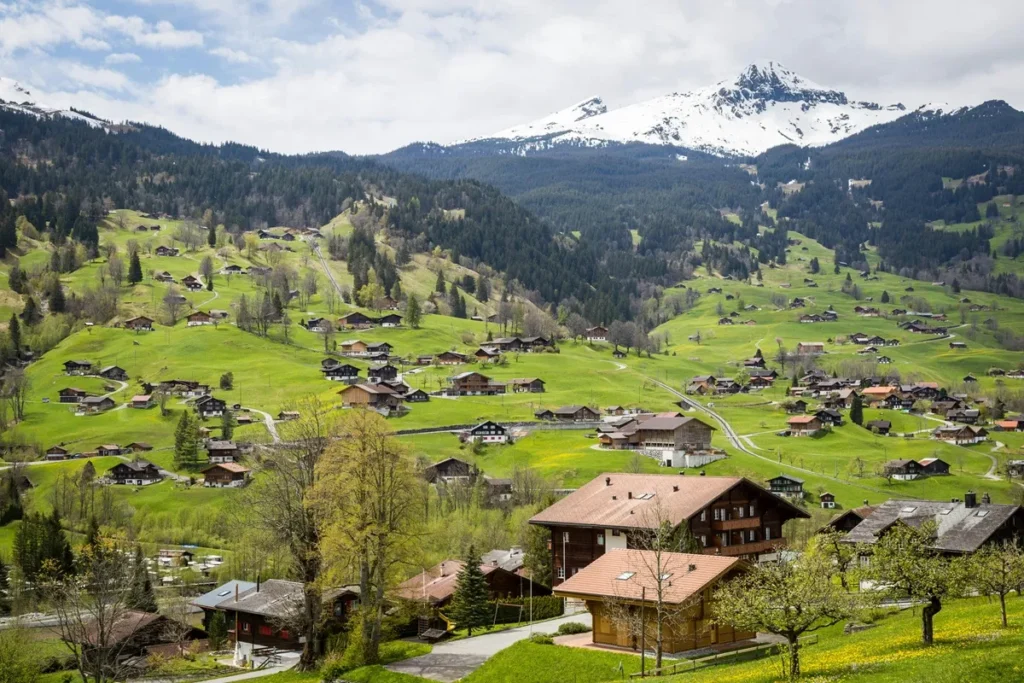
Summer is when Switzerland flexes. Everything is green, the lakes are a shocking shade of turquoise, and everything works. This is the most popular time to visit, and for good reason, but it comes with significant logistical challenges for us drivers.
The Access Advantage
By mid-June, the snow clearing teams have usually punched through the last massive drifts on the highest passes. If your dream is to drive the “Big Three” loop (Furka, Grimsel, Susten) in one day, this is your safest window.
The days are incredibly long. In late June, the sun doesn’t set until after 9:30 PM. This gives you massive driving days. You can take your time, stop for a two-hour lunch, hike a trail, and still reach your campsite and set up while it is bright daylight.
The Heat Wave
People assume Switzerland is always cold. They are wrong. In the valleys, especially the Rhone Valley or around Lake Geneva, temperatures frequently hit 30°C to 35°C (86°F to 95°F) in July and August.
Here is the catch: Air conditioning is not standard in Switzerland. Many older hotels, guesthouses, and even some campsites do not have it. If you are sleeping in a van or trailer, ensure you have good ventilation.
The Trailer Warning
July and August bring out the “Sunday drivers.” These are tourists who are terrified of the mountain drops and drive at 20 km/h in the middle of the road.
If you are towing, this is high-stress. On narrow passes, you will frequently encounter situations where a massive tour bus is coming down while you are going up. The bus often cannot reverse. That means you have to reverse your trailer, sometimes around a blind corner, with a line of impatient cars behind you. If you are not 100% confident in your towing skills in tight, steep spaces, stick to the wider valley highways during these months.
Winter: December to March (The Snow Season)
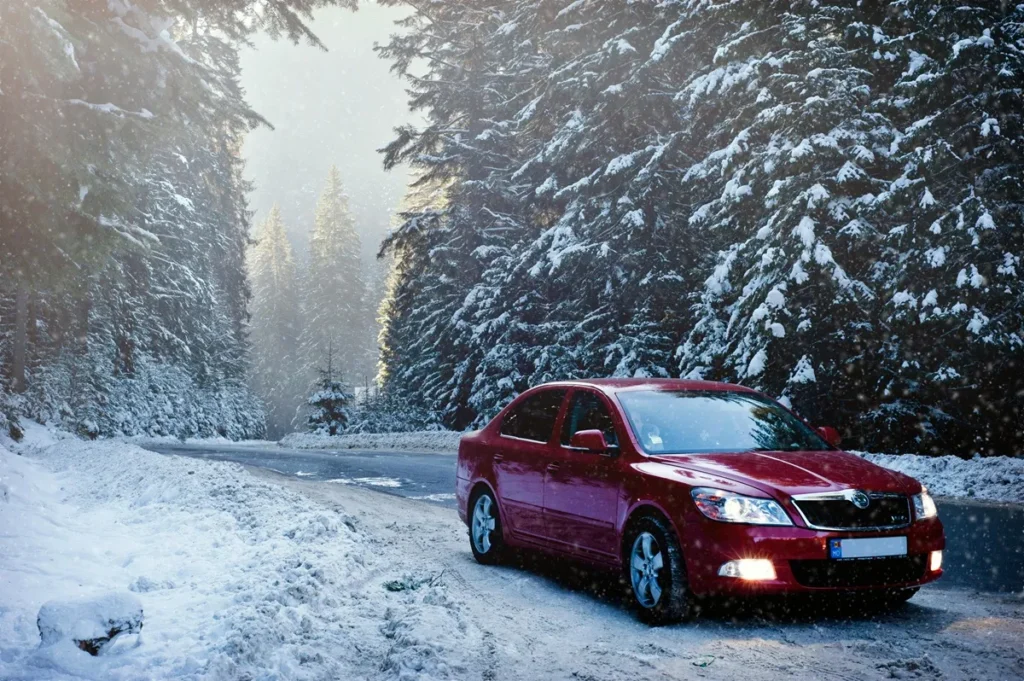
Switzerland in winter is exactly what you see on the chocolate boxes. It is magical, cozy, and silent. However, for a road trip, it is a logistical puzzle.
The Road Conditions
Unless you are staying in the flatlands, you must have winter tires. It is not legally mandatory on all roads, but the law states you must not impede traffic. If you slide across the road and block a tram or a bus because you have summer tires, the police will fine you, and your insurance may void your coverage.
Snow chains should be in your trunk, and more importantly, you should practice putting them on in your driveway at home. Learning how to fit chains for the first time on the side of the Bernina Pass, in the dark, with freezing fingers and slush spraying you from passing trucks, is a miserable experience.
The Closed Doors
Forget the high passes. The scenic routes you saw on Instagram are buried under 10 meters of snow. They become skweruns. To get between valleys (like going from the north to the Ticino south), you will rely on tunnels or “Car Trains.”
Car Trains (Autoverlad) are an experience in themselves. You drive your car (or camper) onto a flatbed rail car, put on your handbrake, and sit inside your vehicle while the train shoots through a mountain tunnel. The Vereina Tunnel and the Furka Tunnel are the most common ones. It’s efficient, but it costs money (usually 30 to 40 CHF per trip).
December Note: December is risky for snow. Often, the lower elevations just get cold rain. If you want the “Winter Wonderland,” go in late January or February.
The “Mud Season”: April, May, and November
We have a love-hate relationship with the shoulder season. Mostly hate.
April and May
This is the awkward transition. Down by the lakes, it can be stunning, flowers blooming, magnolias popping, people sitting in cafes. But as soon as you gain elevation, it turns ugly. The snow is melting, creating brown slush and mud everywhere. Hiking trails are closed due to avalanche risk or mudslides. The skwelifts have stopped running, but the summer trains haven’t started yet.
The high passes are still closed. You can drive to the base of the mountains, stare up at them, and then turn around.
Go only if: You plan to stick strictly to the cities (Zurich, Geneva, Bern, Lucerne) and the low-elevation lakes. If you are a hardcore road tripper wanting alpine glory, you will be disappointed.
November
This is statistically the gloomiest month. The days are short. The high fog (Hochnebel) sets in, blanketing the valleys in a thick gray soup that can last for weeks. It’s too early for good snow, but too late for hiking. Many hotels and cable cars close completely for their annual maintenance and staff holidays.
Essential Road Trip Logistics for Switzerland
If you are bringing a rig, this section is your bible. Switzerland is efficient, but it is strict.
1. The Vignette (Toll System)
Switzerland does not have toll booths on the highway. Instead, they use a “Vignette” system.
- The Cost: It costs 40 CHF.
- The Catch: If you are towing a trailer or caravan, you need two vignettes. One for the towing vehicle, one for the trailer. That is 80 CHF total.
- The Update: You can now buy an E-Vignette online linked to your license plate. We highly recommend this. The physical stickers are notoriously difficult to scrape off your windshield at the end of the year.
- Validity: It lasts for the calendar year (technically from December 1st of the previous year to January 31st of the following year). Even if you visit for just 3 days in December, you buy the full year pass.
2. Mountain Pass Opening Dates
These dates are estimates based on historical data. They change every year depending on the snowpack. Always check the website Alpen-Pässe.ch the morning before you drive.
- Oberalp Pass: Usually opens late April or early May.
- Gotthard Pass: The historic cobbled route usually opens ‘mid to late’ May.
- San Bernardino Pass: Opens late May.
- Furka Pass: Opens early June (often one of the last).
- Grimsel Pass: Opens early June.
- Susten Pass: Opens mid-June. This is often the very last pass to open because of heavy avalanche risk.
3. Driving Culture and Rules
- Speed Limits: Generally 120 km/h on motorways, 80 km/h on open roads, and 50 km/h in towns.
- Trailer Speed: If you are towing, your max speed is 80 km/h on the highway. You will see trucks doing 90. Do not join them. Speed cameras are everywhere, and they are often hidden in gray boxes that blend into the concrete.
- Fines: Swiss speeding fines are aggressive. A minor infraction is a set fee. A major infraction is calculated based on your income and can run into the thousands of francs.
- Mountain Priority: On narrow mountain roads where two vehicles cannot pass, the vehicle driving uphill has priority. The vehicle driving downhill must reverse. However, heavy vehicles (trucks, buses) always have priority over light vehicles (cars), regardless of direction. And the yellow “PostBus” has priority over everyone, always. If you hear their distinctive three-tone horn, move out of the way.
4. The “Yellow Circle” Sign
You will see a sign that is a white circle with a black diagonal line across it (sometimes on a yellow background). This means “End of Speed Limit.” It does not mean “No Limit.” It means the speed limit defaults back to the national standard for that road type (usually 80 km/h on rural roads).
Regional Nuances: Where to go When
Switzerland is small, but the weather varies wildly from canton to canton.
Ticino (The Italian South). This is the sun trap of Switzerland. When it is raining in Zurich, it is often sunny in Ticino.
- Best Time: April and May are fantastic here. While the north is muddy, Ticino feels like the Mediterranean. Camellias and palm trees grow here.
- The Vibe: It feels like Italy, but the trains run on time. Pizza, gelato, and espresso are the staples.
The Valais (South West). Home to the Matterhorn and the driest climate in the country.
- Best Time: July to October. This region gets 300 days of sunshine a year. It is a desert climate in some parts. The vineyards turn gold in October, which is spectacular.
The Bernese Oberland (Interlaken, Grindelwald). This is the tourist epicenter.
- Best Time: In July and August, Interlaken is arguably the most crowded place in the country. It can feel like a theme park. Wait for September when the crowds thin out, and you can actually enjoy the view of the Eiger without being elbowed.
A Note on “Wild Camping”
We need to be very clear about this because we see travelers get in trouble every year.
Wild camping (boondocking) is generally not legal in Switzerland.
Unlike Scandinavia or parts of the USA, you cannot just pull over onto a gravel patch or a forest road and sleep for the night. The rules vary by canton and municipality, which makes it confusing, but generally:
- Nature Reserves: Strictly forbidden. Heavy fines.
- Private Land: Only with permission from the farmer/owner.
- Pass Summits: Some passes tolerate overnight stays in campervans (like the Grimsel Pass summit), but this changes rapidly. Look for “No Camping” signs. They are enforced.
Your best bet is the network of official campsites or the “TCS” (Touring Club Suisse) sites. They are clean, well-run, but expensive. In the high season (July/August), you must book these weeks in advance. You cannot just roll up at 6 PM and expect a spot.
Final Verdict: The Decision Matrix
Let’s simplify this.
- Go in September if you want the perfect balance of drivable roads, stable weather, fewer crowds, and the beauty of the harvest season. This is the driver’s choice.
- Go in July if you have school-aged kids, if you want to swim in the lakes, or if you absolutely must drive the highest passes and can’t risk them being closed by late-season snow.
- Go in January if you are here to skew and don’t care about driving the scenic passes.
- Avoid November and April unless you are visiting a city for a specific museum or business.
Switzerland demands respect. It is expensive, the roads are narrow, and the weather is manic. But when the fog clears on the Julier Pass and you see the Engadine lakes shimmering below you like spilled mercury, you won’t care about the cost of the vignette or the price of the diesel. You’ll just be glad you’re there.