- Spain vs Portugal: The Ultimate Road Trip Showdown (And Why It’s Closer Than You Think)
- The Driving Reality: Pavement, Drivers, and The Trailer Test
- The Wallet Hit: Costs Breakdown (2025/2026 Edition)
- Portugal: The Crackdown
- Spain: The Gray Area
- The Vibe: Fiestas vs. Fado
- Regional Spotlights: Where to Go?
- The Food Fight: Tapas vs. Petiscos
- The Verdict: Which One is For You?
- My Personal Pick?
- Final Advice for the Road
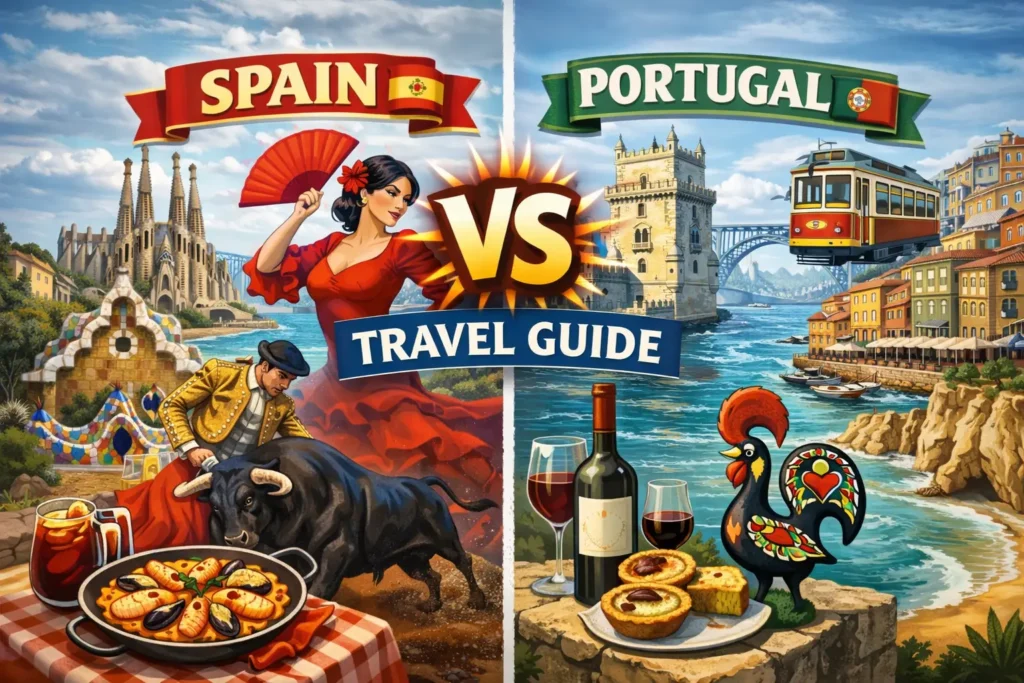
Spain vs Portugal: The Ultimate Road Trip Showdown (And Why It’s Closer Than You Think)
Let’s get one thing straight immediately: if you think Spain and Portugal are basically the same country with different accents, you’re about to have a very rude awakening at the border.
I remember crossing from Galicia into Northern Portugal last autumn. One minute, I was cruising on a wide, well-paved Spanish autovía, sipping a cortado that cost me €1.40. Ten minutes later, I was dodging a Mercedes tailgating me on a narrow Portuguese backroad, my phone screaming about electronic tolls I hadn’t paid yet, realizing my diesel budget was about to take a beating.
They are siblings, yes. But they are the kind of siblings who haven’t spoken in years and have completely different life philosophies.
For the readers of yourtraveltrailer.com, this isn’t just about which country has better beaches. It’s about logistics. It’s about towing a 20-foot rig through a medieval village versus cruising a six-lane highway. It’s about where you can legally park for the night without a knock on the window at 3 AM.
I’ve driven thousands of kilometers across the Iberian Peninsula trailers attached, campervans loaded, and sometimes just a beat-up rental car. Here is the unvarnished, data-backed, mud-on-the-tires comparison of Spain vs. Portugal.
The Driving Reality: Pavement, Drivers, and The Trailer Test
If you are towing or driving a large rig, this section is your bible. The difference in driving culture and infrastructure between these two is night and day.
Spain: The King of Infrastructure
Spain loves concrete. Over the last two decades, they have poured billions into their road network. The result? It is a dream for RVers.
- The Roads: Wide, well-maintained, and massive. You can cross the entire country on high-speed autovías (A-roads) without paying a cent. Even the secondary roads usually have decent shoulders.
- The Drivers: Generally predictable. They drive fast, but they signal. They respect lane discipline more than their western neighbors.
- The Trailer Test: 9/10. You can tow a 30-foot trailer into almost any major Spanish city outskirts without sweating. Service stations are huge, with dedicated truck/caravan parking.
Portugal: The Wild West of the West
Portugal is rougher around the edges. It has charm, but that charm comes with potholes and heart palpitations.
- The Roads: The highways (Autoestradas) are excellent but expensive (more on that later). The moment you leave the toll roads, quality drops instantly. Secondary roads are often narrow, lacking shoulders, and lined with stone walls that seem to lean toward your side mirrors.
- The Drivers: Portuguese drivers are technically skilled but aggressive. Tailgating is a national sport. If you are doing the speed limit in a camper, expect a Fiat Punto to be inches from your bumper flashing its lights.
- The Trailer Test: 6/10. Be careful in the villages. I once got a 7-meter van stuck in a “two-way” street in Coimbra that was barely wide enough for a donkey. If you have a wide rig, stick to the main arteries and check your GPS for “truck” routes.

The Wallet Hit: Costs Breakdown (2025/2026 Edition)
You might assume Portugal is cheaper. Ten years ago, you’d be right. Today? It’s complicated.
-
Fuel Prices
This is where Portugal hurts.
- Spain: Diesel currently hovers around €1.40 – €1.50 per liter.
- Portugal: You are looking at €1.70 – €1.80 per liter.
- The Math: On a 2,000km road trip in a vehicle getting 10L/100km, you spend €60 more on fuel just by being in Portugal. Fill up in Badajoz before you cross into Elvas. Trust me.
-
Tolls
- Spain: Mostly Free. Spain has been removing The famous AP-7 along the Mediterranean is now largely free. You can drive from France to Alicante without opening your wallet if you pick the right route.
- Portugal: Expensive and Confusing. Portugal uses a mix of traditional booths and electronic-only gantries. If you don’t have a transponder, you have to go to a PayShop within 5 days to pay, or register your credit card at the border “EasyToll” machines. It is a hassle, and it adds up fast. A drive from Lisbon to Porto can cost you €25+ in tolls alone for a Class 2 vehicle (which includes most campers).
-
Food & Drink
- Portugal: You can still find a prato do dia (dish of the day) for €8-€10 including a drink and coffee. An espresso (bica) is 70 cents.
- Spain: A menú del día is now closer to €12-€15. Coffee is usually €1.20+. However, in cities like Granada or León, the tapas come free with your drink, which balances the scales if you drink enough wine.
-
Campsites
- Spain: Generally more expensive (€25-€40/night) but better facilities (pools, super-markets, wide pitches).
- Portugal: Cheaper (€15-€25/night), but often more rustic. Electrical hookups can be sketchy in older municipal sites.
The “Van Life” Law: Wild Camping
This is the most critical update for our audience. The days of parking anywhere on the Algarve coast are over.
Portugal: The Crackdown
In 2021, Portugal banned wild camping. They walked it back slightly, but restrictions remain tight in 2026.
- The Rule: You can stay overnight in “approved” motorhomes for up to 48 hours in the same municipality, but only where not explicitly prohibited.
- The Catch: It is explicitly prohibited in almost all the places you want to be. The entire Costa Vicentina (Southwest coast) and much of the Algarve are protected zones (Nature 2000). The GNR (police) patrol these areas aggressively. Fines range from €60 to €600.
- The Reality: Use the apps (Park4Night). Look for ASAs (Service Areas). Do not risk wild camping near the beach in high season. You will get a knock.
Spain: The Gray Area
Spain distinguishes between “Parking” and “Camping.”
- Parking: You are parked if your wheels are touching the ground (no leveling blocks) and nothing extends beyond the vehicle perimeter (no awnings, no windows popped open outwards, no chairs outside). You can sleep inside a parked vehicle.
- Camping: As soon as you put out a chair or a stabilizer leg, you are camping. This is illegal outside campsites.
- Enforcement: It varies wildly. In Tarifa or Valencia, they are strict. In the interior of Castile, nobody cares.
Winner: Spain, simply because the rules allow for “stealth camping” legally if you are just parking to sleep. Portugal’s specific bans on protected coastlines make it harder for beach lovers.
The Vibe: Fiestas vs. Fado
This is subjective, but it affects how your trip feels.
Spain: Outward & Loud
Spain lives in the street. It is noisy. Dinner doesn’t start until 9:30 PM (earliest). If you arrive at a restaurant at 7 PM, the staff will be eating their own lunch.
- The Energy: It’s high-octane. People shout across the bar. It’s chaotic but welcoming.
- The Schedule: Everything closes from 2 PM to 5 PM (Siesta is real in retail, if not in corporate offices). Sundays are dead zones.
Portugal: Inward & Melancholic
Portugal feels older, slightly more crumbled, and quieter.
- The Energy: The Portuguese have Saudade—a deep, nostalgic longing. It’s in the music (Fado) and the attitude. People are incredibly polite, speak English better than the Spanish (generally), but are more reserved.
- The Schedule: They eat earlier. Lunch at 1 PM, dinner at 8 PM. It feels more aligned with Northern European clocks, which is easier for many travelers.
Regional Spotlights: Where to Go?
Do not try to do both countries in two weeks. You will fail. Pick a lane.
If you choose Spain…
- North (Galicia/Asturias): This is “Green Spain.” It looks like Ireland. Rain, rugged cliffs, cider houses, and bagpipes. The roads are twisty but beautiful. Best for: Nature lovers who hate the heat.
- South (Andalusia): The classic Spain. Moorish palaces, white villages (pueblos blancos), and dry heat. Best for: History buffs and winter road trips (it stays warm).
- East (Mediterranean Coast): Concrete heavy in parts, but Valencia and the Costa Brava offer incredible food and coves. Best for: Beach bums who don’t mind crowds.
If you choose Portugal…
- North (Douro Valley/Porto): Steep terraced vineyards and granite cities. The driving here is terrifying (steep drops), but the scenery is world-class. Best for: Wine drinkers and serious drivers.
- South (Alentejo/Algarve): Alentejo is the Texas of Portugal—flat, dry, cork trees, empty roads. The Algarve is tourist central, but the cliffs are iconic. Best for: Sun seekers and surfers.
The Food Fight: Tapas vs. Petiscos

You have to eat. Here is what you are putting in your mouth.
Spain: The King of Pork
Spanish food is bold. heavy on salt, olive oil, and garlic.
- Must Eat: Jamón Ibérico (it ruins all other ham for you), Salmorejo (cold tomato cream), Croquetas.
- The Trap: Avoid “Paella” signs with pictures of the food outside. That is frozen yellow rice for tourists. Real Paella takes 40 minutes to cook.
Portugal: The Ocean’s Table
Portuguese food is honest. They don’t hide the ingredients.
- Must Eat: Bacalhau (Salt cod—they have 365 recipes for it), Polvo à Lagareiro (Octopus roasted in oil), and of course, the Pastel de Nata.
- The Trap: In restaurants, the waiter will put bread, cheese, and olives on your table. These are not free. If you eat them, you pay. If you don’t touch them, they take them away. This confuses tourists daily.
The Verdict: Which One is For You?
I love both, but they serve different urges.
Choose Spain if:
- You have a large vehicle (7m+).
- You want free highways and easier driving conditions.
- You thrive on energy, nightlife, and historical grandeur.
- You want to park up and sleep without constantly checking a “protected zone” map.
- You are traveling in winter (Southern Spain is the warmest place in Europe).
Choose Portugal if:
- You are in a smaller van or car (easier to navigate the villages).
- You want better waves (the surf is superior).
- You prefer a slower, quieter pace of life.
- You are on a food budget (dining out is 20-30% cheaper).
- You want that raw, “end of the world” Atlantic feeling.
My Personal Pick?
If I had two weeks in a van right now? I’d do Northern Spain (Asturias) dropping down into Northern Portugal (Gerês). You get the best mountains, the best food, and you avoid the tourist traps of the southern coasts.
Just remember: If you choose Portugal, fill up the tank before you cross that border.
Quick Comparison Table
| Feature | Spain | Portugal |
| Fuel Cost | ⭐⭐⭐⭐ (Cheaper) | ⭐⭐ (Expensive) |
| Road Quality | ⭐⭐⭐⭐⭐ (Excellent) | ⭐⭐⭐ (Good Highways, Bad Rural) |
| Tolls | ⭐⭐⭐⭐ (Mostly Free) | ⭐ (Expensive & Complex) |
| Food Prices | ⭐⭐⭐ (Moderate) | ⭐⭐⭐⭐ (Cheap) |
| Wild Camping | ⭐⭐⭐ (Gray Area/Tolerated) | ⭐ (Strict/Risky) |
| English Spoken | ⭐⭐ (Hit or Miss) | ⭐⭐⭐⭐ (Widely Spoken) |
| Vibe | Loud, Late, Energetic | Quiet, Melancholic, Polite |
Final Advice for the Road
Regardless of where you go, download the “Via Verde” app if you hit Portugal, and “Park4Night” for both. Don’t plan too much. The best moments in both these countries happen when you take a wrong turn down a dirt road and end up sharing a bottle of wine with a local farmer who doesn’t speak a word of your language.
That is the freedom we are chasing.