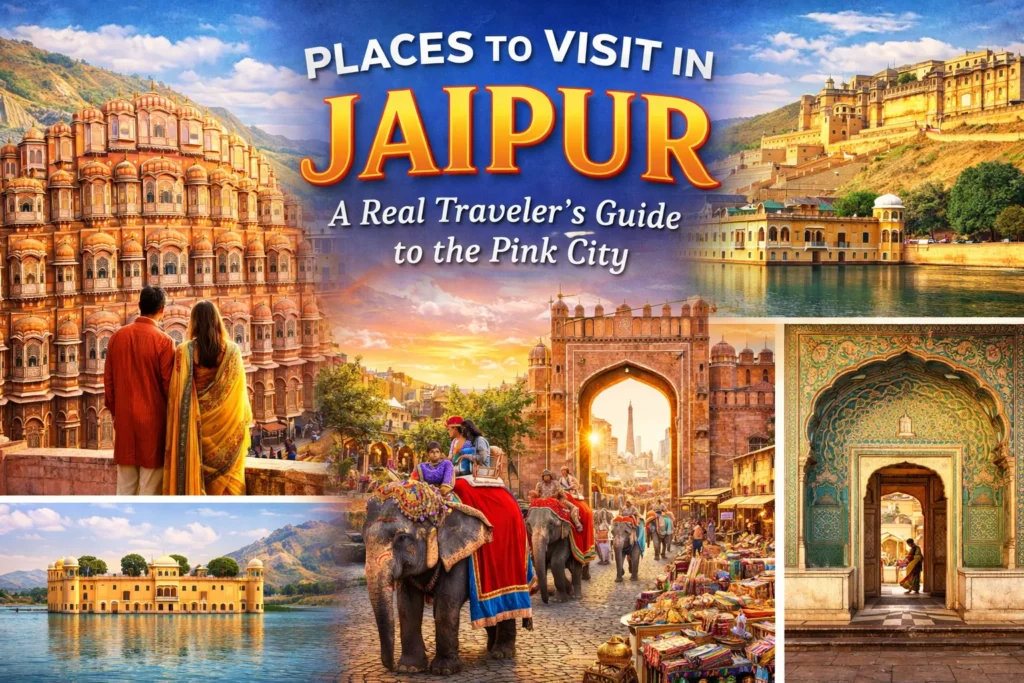
Look, I’m going to be honest with you. Jaipur hits you like a freight train.
The moment you roll off the highway and hit the city limits, it’s a sensory overload. You’ve got camels hauling carts in the left lane, tuk-tuks weaving through gaps that shouldn’t exist, and pink sandstone walls that glow so bright in the midday sun they almost hurt your eyes.
If you’re reading this, you probably aren’t looking for the standard “museum tour” checklist. You’re a traveler. Maybe you’re in a rental car, maybe you’ve got a camper (good luck, I’ll get to that later), or maybe you’re just backpacking through Rajasthan with a thirst for something real.
I’ve driven through Jaipur more times than I can count. I’ve been scammed, I’ve gotten lost in the bazaars, and I’ve eaten enough pyaz kachori to regret it the next morning. And through all that, I’ve fallen in love with this chaotic, beautiful, dusty mess of a city.
This isn’t just a list of monuments. This is a deep dive into how to actually experience Jaipur without losing your mind. We are going to cover the heavy hitters, sure, but I’m also going to tell you where to park your rig, where to find the best lassi of your life, and how to escape the crowds when it all gets too much.
Grab a chai. Let’s map this out.
The “Big Three” Forts: A Hiker’s & Driver’s Paradise
You cannot come to Jaipur and skip the forts. It’s illegal. Okay, not really, but it should be. The Aravalli Hills hug the city, and perched on top are three massive structures that tell the story of this region better than any guidebook.
-
Amber Fort (Amer Fort): The Showstopper
This is the big one. If you only visit one fort, make it Amber. It’s huge, opulence is off the charts, and it dominates the skyline about 11km out of the main city.
- The Vibe: It feels like a movie set. The sandstone changes color depending on the time of day—honey-gold at sunrise, harsh yellow at noon, and deep orange at sunset.
- The Climb: You can walk up the ramp (it’s steep but doable), take a jeep, or—and I strongly advise against this—take an elephant. The elephant rides are controversial due to animal welfare concerns. As a traveler who loves nature, I say skip it. Walk up. You earn the view.
- Don’t Miss:
- The Sheesh Mahal (Mirror Palace): Imagine a room covered in millions of tiny convex mirrors. Legend says a single candle could light up the entire hall. It’s stunning.
- The Tunnels: There’s a subterranean tunnel connecting Amber to Jaigarh Fort. It’s dark, cool, and feels like a secret passage.
- Parking Tip: There is a designated parking lot down below near the Maota Lake. If you are driving a larger vehicle or a camper, do not try to drive up the narrow ramp to the top gate. Park at the bottom and hike or take a jeep.
-
Jaigarh Fort: The Military Beast
Most tourists do Amber and leave. That is a mistake. Jaigarh sits directly above Amber. While Amber was for luxury, Jaigarh was for war.
- Why Go: It’s rugged. It lacks the delicate mosaics of Amber, but it makes up for it with raw power. This fort was never conquered.
- The Cannon: It houses “Jaivana,” which was at one point the world’s largest cannon on wheels. It was fired exactly once (test fire), and apparently, the shockwave was so strong it caused structural damage nearby.
- The Drive: You can actually drive your car all the way inside Jaigarh Fort. Yes, you pay a toll at the gate, and you can drive right up to the cannon. This is a huge win if you’re tired of walking.
- Best View: The view from the Diwa Burj watchtower is superior to Amber. You look down on Amber Fort and the entire city.
-
Nahargarh Fort: The Sunset Spot
Nahargarh stands on the edge of the Aravalli hills, overlooking the entire city grid.
- The Experience: This is the hangout spot. It’s less about history and more about the vibe. The walls wind along the ridge like a mini Great Wall of China.
- The “Stepwell” Scene: There’s a famous stepwell (Rang de Basanti movie fame) here. It’s free to look at, though they sometimes restrict access to the stairs for safety.
- Road Trip Note: The drive up to Nahargarh is a winding mountain road. It is fantastic fun in a car or on a motorbike. If you have a trailer, disconnect it at your campsite. This road is twisty and narrow in parts.
- Pro Tip: Go at 4:30 PM. Explore the fort, then grab a beer at the restaurant on the edge of the wall (Padao) and watch the city lights turn on.
The Pink City Core: Chaos & Culture
The “Old City” is a grid surrounded by walls. This is where the chaos lives. The traffic here is intense—cows, pigs, camels, Mercedes, and bicycles all fighting for the same inch of asphalt.
Strict Rule: Do not drive a large vehicle in here. Park outside the gates (Ramniwas Bagh parking is a good bet) and take an auto-rickshaw.
-
Hawa Mahal (The Palace of Winds)
You’ve seen the photo. The honeycomb facade.
- The Reality Check: It is essentially a facade. It’s very thin. It was built so royal ladies could watch street festivals without being seen.
- How to View It: Don’t just stand on the street. Cross the road and go up to one of the rooftop cafes (like Wind View Cafe). Order a coffee, sit on the balcony, and get that eye-level shot. It’s much more peaceful than dodging traffic on the sidewalk.
- Inside: You can go inside, but the best view is honestly from the outside. If you’re short on time, this is a “drive-by and photo” stop.
-
City Palace
Right in the center. The royal family still lives here in a private wing.
- The Cost: It’s pricey. There are different ticket tiers. The basic ticket gets you into the museums and courtyards. The “Royal Splendor” ticket (very expensive) gets you into private rooms.
- Is it worth it? The architecture is a fusion of Mughal and Rajasthani. The Pitam Niwas Chowk (courtyard with four gates representing seasons) is incredible. The Peacock Gate is the most famous.
- Weapons Museum: The armoury here is fantastic. Daggers with pistols built into the handles, massive swords—it’s a hit if you like military history.
- Jantar Mantar
This looks like a playground of giant geometric shapes. It is actually an 18th-century astronomical observatory.
- The Cool Factor: These aren’t sculptures. They are working instruments. The massive sundial (Samrat Yantra) tells time to an accuracy of 2 seconds.
- Guide Required: Hire a local guide here. Seriously. Without one, you’re just looking at stone triangles. With one, you realize you’re looking at genius engineering.
Road Tripper Logistics: Driving & Parking in Jaipur
If you are reading Your Travel Trailer, you care about the rig. Here is the lowdown on handling a vehicle in Jaipur.
- The Traffic: It is aggressive. Lane markings are suggestions. The unwritten rule is “might makes right,” but also “watch out for the cows.” Cows have absolute right of way. If a cow sits in the middle of a 3-lane highway, traffic moves around the cow.
- Parking the Rig:
- Old City: Impossible. Do not try.
- Hotels: Many heritage hotels have small driveways. Call ahead and ask specifically: “I have a large SUV/Camper, do you have secure parking?”
- RV/Trailer Spots: Formal RV parks are rare in India. Your best bet is Amrapali Farm or similar farmhouse stays on the outskirts (Sirsi Road or Ajmer Road areas). They often have huge lawns and are happy to let you park and hook up to power for a fee.
- Fuel: Diesel is widely available. DEF (AdBlue) is available at major highway pumps but stock up before you hit the city traffic.
The Food Scene: Eat Like a Local
Jaipur is not the place for a diet. The food is rich, spicy, and laden with ghee (clarified butter).
- Rawat Misthan Bhandar (The Kachori King)
- Order: Pyaz Kachori (Onion Kachori).
- The Experience: It’s near the railway station. It is a madhouse. You buy a token, fight your way to the counter, and get a hot, crispy pastry filled with spicy caramelized onions. Eat it standing up outside. It’s the best breakfast in the city.
- Lassiwala (MI Road)
- The Warning: There are five shops named “Lassiwala” in a row. They all claim to be the original.
- The Real One: Look for “Shop 312” with the black board. They usually sell out by 2 PM.
- The Drink: Lassi (sweet churned yogurt) served in a kulhad (clay cup). It’s thick enough to eat with a spoon. When you’re done, you smash the clay cup in the bin. It’s satisfying.
- Tapri Central
- The Vibe: Hipster cafe meets Indian nostalgia. Rooftop views of Central Park.
- Order: Vada Pav and Masala Chai. Their tea is incredible. It’s a great place to chill for 2 hours and write in your journal.
- Masala Chowk
- Concept: An open-air food court in Ram Niwas Garden.
- Why Go: It collects all the famous street food vendors of Jaipur in one clean, hygienic place. You can try the famous Samrat Samosa, Som Lal’s Rawat Kachori, and Gulab Ji Chai all in one spot without driving across town.
Shopping: The Treasure Hunt
Jaipur is dangerous for your wallet. The craftsmanship here is world-class.
- Johari Bazaar (Jewelry)
- Specialty: Gemstones and silver.
- The Deal: Jaipur is the gem cutting capital of the world. You can find incredible silver jewelry here.
- Haggle: Hard. Start at 50% of the asking price. Keep smiling. It’s a game.
- Bapu Bazaar (Textiles & Shoes)
- Specialty: Mojaris (camel leather shoes) and block-print textiles.
- The Smell: You can smell the leather. The shoes are colorful and comfortable (once broken in).
- Tip: Buy the bedsheets (Sanganeri print). They are lightweight, durable, and look fantastic in a camper van or home.
- Blue Pottery
- What is it: Distinctive blue and white glazed pottery. It doesn’t use clay; it uses quartz powder.
- Where to buy: Kripal Kumbh is the gold standard (more expensive, museum quality). For cheaper everyday pieces, check the shops on Amer Road.
Off The Beaten Path: Escape the Crowds
If the honking gets to you, retreat to these spots.
- Galta Ji (The Monkey Temple)
- Location: 10km east of Jaipur.
- The Vibe: It’s a temple complex built into a narrow crevice between two hills. Natural springs fill seven holy water tanks.
- The Locals: It is overrun with Rhesus Macaques. They are bold. Hide your food. Hide your sunglasses.
- Why Go: It feels like Indiana Jones. The architecture is crumbling and ancient. The hike up to the Sun Temple at the top gives you a view of the city that most tourists miss.
- Patrika Gate
- Location: Jawahar Circle (near the airport).
- The Photo Op: It’s a newer construction, but it’s stunning. A massive pink gate with vibrant, hand-painted walkways inside.
- Crowd: It’s popular with Instagrammers. Go at 7 AM if you want a clean shot.
- Panna Meena Ka Kund
- Location: Near Amber Fort.
- What is it: An ancient stepwell with symmetrical stairs.
- Rule: You can’t go down the stairs anymore (guards are strict), but the view from the top is geometrically satisfying.
Day Trips for the Road Tripper
You have a vehicle. Use it.
- Bhangarh Fort (85km): Known as the “Most Haunted Place in India.” Legally, you are not allowed to enter after sunset. The ruins are eerie and beautiful. The road there is decent, but watch for potholes.
- Pushkar (145km): A sacred town wrapped around a lake. It’s the hippie capital of Rajasthan. Great for a chill vibe. The drive crosses the snake-like Ajmer ghat section—fun driving.
- Sambhar Lake (80km): India’s largest inland salt lake. It looks like the Rann of Kutch. Endless white salt desert. Warning: Do not drive your heavy vehicle onto the salt crust unless you know what you are doing. You will sink.
Practical Survival Tips
- Water: Drink bottled water only. Check the seal.
- Scams:
- The Gem Scam: A friendly local approaches you, says he needs help exporting gems to your country to avoid tax, and he’ll split the profit. Walk away.
- The “Closed” Scam: Your driver tells you the hotel/fort you want to go to is “closed today” for a festival/strike, but he knows another great place. It’s a lie. He wants a commission at the other place. Check Google Maps.
- Best Time to Visit: October to March.
- October/November: perfect weather, festive season (Diwali).
- December/January: Surprisingly cold at night. Bring a jacket.
- April-June: Do not come. It is 45°C (113°F). It is dangerously hot.
The 3-Day Slow Travel Itinerary
Don’t rush. Here is how I would do it.
Day 1: The Royal Introduction
- Morning: Arrive at Amber Fort by 8:00 AM. Beat the heat. Walk the wall.
- Lunch: 1135 AD (restaurant inside Amber Fort) for a splurge, or drive down to town for something local.
- Afternoon: Stop at Panna Meena Ka Kund stepwell. Then visit the Anokhi Museum of Hand Printing (nearby) to see how the textiles are made.
- Evening: Sunset at Nahargarh Fort. Dinner at Padao.
Day 2: The Pink City Hustle
- Morning: Breakfast at Rawat (Pyaz Kachori). Head to City Palace and Jantar Mantar.
- Lunch: Lassiwala for a heavy lassi and maybe some street food at Masala Chowk.
- Afternoon: Photo stop at Hawa Mahal. Then, dive into Johari Bazaar. Get lost in the lanes. Buy some spices or tea.
- Evening: Movie at Raj Mandir Cinema. It’s an art deco meringue of a building. Watching a Bollywood movie here is an experience—the crowd cheers, whistles, and dances.
Day 3: Nature & Spirit
- Morning: Hike up to Galta Ji (Monkey Temple).
- Afternoon: Visit Patrika Gate and then head to Albert Hall Museum (stunning Indo-Saracenic architecture).
- Late Afternoon: Drive out to a village resort like Chokhi Dhani (touristy, yes, but fun) for a traditional Rajasthani thali dinner and folk dancing.
Final Thoughts from the Road
Jaipur is not a city you “see.” It’s a city you survive and then fall in love with. It’s dust in your teeth, the smell of frying spices, and the most incredible sunset you’ve ever seen over a desert ridge.
Park the trailer, get a tuk-tuk, and let the city wash over you. It’s wild, it’s loud, and it is absolutely worth the miles.
Safe travels, and keep the rubber side down.
(Note: Prices and opening times in India change like the wind. Always check locally before driving across town.)
Extended Deep Dive: The Hidden History & Architecture
We have covered the basics, but let’s dig deeper. If you are a history buff or someone who appreciates the “why” behind the “what,” this section is for you.
The Science of the Grid
Jaipur wasn’t an accident. It was the first planned city of medieval India. In 1727, Maharaja Sawai Jai Singh II decided to move his capital from the cramped hills of Amber to the plains. He consulted architect Vidyadhar Bhattacharya, and they used Vastu Shastra (ancient Indian architecture science) to design the city.
Notice the grid? The city is divided into nine blocks (representing the nine planets). The streets are wide—surprisingly wide for the 1700s. They were designed to allow military parades and elephants to pass easily. When you walk the Old City today, you are walking on a grid that was mathematically perfect 300 years ago.
Why Pink?
It wasn’t always pink. The city was originally a mix of pale yellow and white. In 1876, the Prince of Wales (later King Edward VII) visited India. To impress him, the Maharaja ordered the entire city painted pink—the color of hospitality. It stuck. By law, buildings in the walled city must maintain this color. It’s a terracotta salmon hue, actually, but “The Salmon City” doesn’t have the same ring to it.
Specific Gear Guide for Jaipur
If you are packing for this trip, here is what you actually need:
- Slip-on Shoes: You will be taking your shoes off constantly at temples. Laces are your enemy. Birkenstocks or sturdy sandals are gold.
- Scarf/Shawl: For women (and men in some temples), covering heads or shoulders is required. A light cotton scarf is versatile—sun protection, dust mask, and modesty cover all in one.
- Earplugs: If you are sleeping in the city, the honking does not stop. Ever.
- Hand Sanitizer: Use it. Before every meal.
- Power Bank: You will take more photos than you expect. Your battery will die by 2 PM.
RV & Van Life Specifics: Where to Stay
Finding a place to park a rig overnight is the hardest part of an Indian road trip.
- Reliable Farmstays As mentioned, look for “Farm Houses” on Google Maps on the periphery of the city.
- La Villa Farm: Often accommodates overlanders.
- The various “Resorts” on Sikar Road: Many have large wedding lawns. If there is no wedding, they are often happy to rent you a parking spot with access to a bathroom for a small fee (500-1000 INR).
- Water & Waste
- Water: Do not fill your RV tank with tap water for drinking. Use it for washing only. Buy 20L Bisleri jars for drinking/cooking. You can swap these jars at any grocery store.
- Waste (Black Water): There are NO dump stations. None. You must use a cassette toilet and empty it in a regular toilet (ask permission) or dig a hole deep in the wilderness (far from the city). Do not dump on the roadside.
- Mechanical Help
- Jaipur is a hub for mechanics. If you have a mechanical issue with a truck or SUV, the “Transport Nagar” area is where the heavy mechanics live. They can fix anything with a hammer and ingenuity. It won’t be pretty, but it will work.
A Note on “The look”
You will be stared at. If you are driving a foreign vehicle or look like a tourist, locals will stare. It is not aggressive; it is curiosity. In rural Rajasthan, people might just stand and watch you eat or park.
- How to handle it: Smile. Wave. Say “Namaste.” usually, the stare breaks into a massive grin. If you get annoyed, you will have a bad time. Embrace the celebrity status.
Souvenirs That Are Actually Cool (Not Fridge Magnets)
- Lac Bangles Head to the “Maniharon ka Rasta” (Lane of Bangle Makers) in Tripolia Bazaar. You can watch them melt the lac (natural resin) over charcoal fires and shape the bangles. It’s mesmerizing.
- Block Print Wood Blocks Don’t just buy the fabric; buy the old wooden blocks used to print them. They make amazing paperweights or shelf decor. You can find piles of retired blocks in shops near Hawa Mahal.
- Spices Go to the spice market. Buy “Mathania Chili” (a bright red, flavorful chili from Rajasthan) or fresh turmeric. It costs pennies compared to home and the flavor is explosive.
Safety for Solo Female Travelers
Jaipur is generally safe, but it is a conservative city in a patriarchal state.
- Dress: modest dress helps avoid unwanted attention. loose pants and kurtas (tunics) are perfect for the heat and blend in better.
- Night: The Old City empties out early (by 9-10 PM). Uber is reliable and safer than hailing random tuk-tuks at night.
- Intuition: If a shopkeeper is being too pushy or a “guide” won’t leave you alone, be firm. A loud “NO” is respected.
The “Instagram vs. Reality” Check
Patrika Gate:
- Instagram: Empty, ethereal, perfect symmetry.
- Reality: There are usually 5 couples doing pre-wedding shoots, a TikTok dancer, and a family picnic. You have to wait your turn for the shot.
Hawa Mahal:
- Instagram: Peaceful, windy palace.
- Reality: It faces a main road that is one of the noisiest in Jaipur. The sound of engines is deafening. That’s why I recommend the rooftop cafes across the street—they are above the noise layer.
Regional Dishes You Might Miss
Everyone eats Dal Baati Churma (lentils, baked wheat balls, and sweetened crushed wheat). But try these:
- Gatte ki Sabzi: Gram flour dumplings in a yogurt curry. It’s tangy and spicy.
- Ker Sangri: A desert bean and berry vegetable dish. It looks like dried twigs, but it tastes like a savory, spicy pickle. It’s a survival food of the desert and is delicious with bajra roti (millet bread).
- Ghevar: A disc-shaped sweet made of flour and soaked in sugar syrup. It’s a honeycomb texture. Malai Ghevar (topped with cream) is the upgrade.
Exit Strategy: Where Next?
Jaipur is the gateway.
- West: To Jodhpur (The Blue City) and Jaisalmer (The Golden City). This is the true desert road trip.
- South: To Udaipur (The White City/Lakes). The roads are winding and green (in monsoon).
- East: To Agra (Taj Mahal) and Ranthambore (Tigers).
The road out of Jaipur towards Ajmer (NH 48) is a 6-lane highway. It’s smooth, fast, and boring. If you want adventure, take the state highways through the villages. You’ll see peacocks sitting on fences and men with neon turbans smoking hookahs on charpoys. That is the real Rajasthan.
Go get lost. You’ll find yourself.