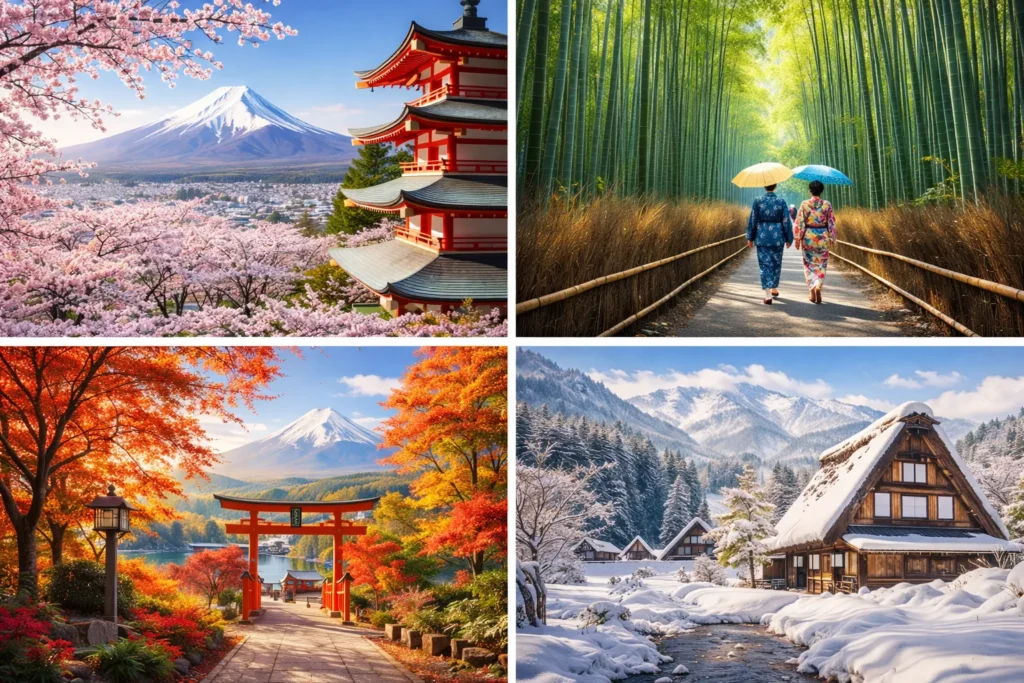
- Best Time to Visit Japan: The Real Talk Guide for Road Trippers & Explorers
- The Quick Verdict (If you’re in a Rush)
- Spring: Sakura, Slush, and The Golden Week Trap
- Summer: Humidity, Typhoons, and The Northern Escape
- Autumn: The Golden Season for Drivers
- Winter: Powder Snow and Technical Driving
- Regional Breakdown: Where to Go When
- Road Trip Logistics by Season
- Month-by-Month “Cheat Sheet”
- The Money Factor: When is it Cheapest?
- Conclusion: Choosing Your Own Adventure
- FAQ: Frequently Asked Questions
Best Time to Visit Japan: The Real Talk Guide for Road Trippers & Explorers
I still remember the first time I drove a rental campervan through Hokkaido in February. I thought I was ready. I had the 4WD, the snow tires, and a thermos of hot coffee. But when a whiteout hit near Niseko and the road markers vanished into a wall of white, I realized something important: timing in Japan isn’t just about pretty pictures. It’s about survival, road conditions, and knowing exactly what you’re signing up for.
If you are planning a trip to Japan—especially if you plan to get behind the wheel—you need more than just a cherry blossom forecast. You need to know when the mountain passes close for winter, when the typhoons shut down the expressways, and when the humidity makes sleeping in a van unbearable.
The Quick Verdict (If you’re in a Rush)
- Best All-Rounder: October & November. The humidity breaks, the air is crisp, the foliage is unreal, and the roads are dry.
- Best for Road Trips: May (Post-Golden Week). The snow has melted in the mountains, the greenery is neon-bright, and the summer rains haven’t started.
- Best for Snow Sports: January & February. Deepest powder in the world (Japow), but driving is technical and demanding.
- The “Danger Zone”: Golden Week (Late April/Early May). Avoid this at all costs. Traffic jams can stretch for 30+ kilometers, and accommodation prices triple.
Spring: Sakura, Slush, and The Golden Week Trap
(March – May)
Spring is the poster child of Japanese tourism. You’ve seen the photos. Pink flowers, blue skies, everyone having a picnic. And yes, it is spectacular. But for a road tripper, spring is a mixed bag of conditions.
The Cherry Blossom Chase (Sakura)
The blooms start in the south (Okinawa) as early as January and hit the main island (Honshu) in late March.
- Tokyo/Kyoto: Usually peaks late March to early April.
- Hokkaido: blooms land in late April or early May.
The Road Trip Reality:
If you rent a car to chase the blossoms, you have a massive advantage over the train crowds. You can drive to remote spots like the Mount Yoshino backroads or the Izu Peninsula coastline where the trains don’t go.
However, you need to be careful with your tires. In March, it might be 15°C (59°F) in Tokyo, but if you drive into the Japanese Alps (Nagano, Gifu), the roads will still be frozen. Rental agencies in Tokyo might switch to summer tires too early. Always request snow tires if you plan to head into the mountains before mid-April.
The Golden Week Warning
I cannot stress this enough: Do not plan a road trip during Golden Week.
This takes place from April 29 to May 5.
Nearly the entire country gets time off. The expressways become parking lots. Hotels are booked out six months in advance. Campsites are packed tent-to-tent. If you must visit during this time, stay in one city and use the subway. Do not get on the highway.
The “Secret” Sweet Spot: Mid-May
Once Golden Week ends, Japan takes a breath. The second and third weeks of May are arguably the best driving weather of the year.
- Prices drop.
- Crowds vanish.
- The rice fields are flooded, creating mirror-like reflections of the mountains.
- You can drive with the windows down.
Summer: Humidity, Typhoons, and The Northern Escape
(June – August)
Summer in Japan is intense. It is not the “dry heat” of California. It is a heavy, wet blanket of humidity that hits you the moment you step outside. But it is also the season of festivals, fireworks, and the legendary Hokkaido road trip.
The Rainy Season (Tsuyu)
From early June to mid-July, the main island sits under a rain front. It doesn’t rain every single hour, but it is gray, wet, and humid.
- Driving Impact: Mountain roads can get foggy. Visibility drops. Landslides are rare but possible on older mountain passes.
- Camping Impact: Drying gear is impossible. If you are vanning, make sure you have ventilation fans.
The Heat Dome (August)
August temps regularly hit 35°C (95°F) with 80% humidity in Tokyo and Kyoto. Sightseeing becomes an endurance sport. You walk two blocks and you are drenched.
However, this is the best time for:
- Mount Fuji Climbing: The trails are open, and the snow is gone.
- Festivals (Matsuri): This is when the massive events happen. The Gion Matsuri in Kyoto (July) and Awa Odori in Tokushima (August) are loud, sweaty, and incredible.
- Beaches: The Izu Peninsula and Okinawa are prime.
The Hokkaido Escape
This is the pro move. Hokkaido (the northern island) does not have a rainy season. When Tokyo is sweltering, Hokkaido is a breezy 24°C (75°F).
- The Route: Fly into Sapporo (Chitose Airport), rent a campervan, and drive the Garden Path through Furano and Biei.
- The Sights: Lavender fields are purple explosions in July. The roads are wide, straight, and American-style, making it the easiest place to drive in Japan.
Typhoon Season
Technically runs from June to October, but the big ones usually hit in August and September.
If a typhoon is coming:
- Do not drive. High winds can flip kei-cars (light vehicles) and campervans on bridges.
- Trains will
- Shops will
Wait it out in your hotel. They usually pass in 24 hours.
Autumn: The Golden Season for Drivers
(September – November)
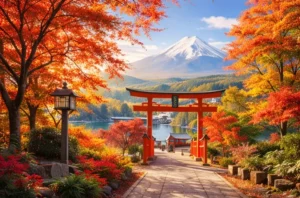
If I had one week to drive Japan, I would pick late October. The humidity is gone, the food is at its peak (they call it “Autumn Appetite”), and the scenery is a riot of red, orange, and gold.
Foliage (Koyo) Timing
Unlike cherry blossoms (which last a week), autumn leaves last nearly a month in each area.
- Hokkaido/Alps: Mid-September to Mid-October.
- Tokyo/Kyoto: Late November to early December.
Best Autumn Drives
- Bandai-Azuma Skyline (Fukushima): A winding mountain road that cuts through volcanic landscapes and burning red forests.
- Irohazaka Winding Road (Nikko): Famous for 48 hairpin turns. It is spectacular, but go early (6 AM) to beat the tour buses.
- Metasequoia Avenue (Shiga): A straight road lined with massive trees that turn deep orange.
Temperature Check
- September: Still feels like summer. Typhoon risk is high.
- October: T-shirt days, sweater nights.
- November: You need a jacket.
This is also the best season for Onsen (Hot Spring) hopping. Nothing beats a cold outdoor bath surrounded by falling maple leaves.
Winter: Powder Snow and Technical Driving
(December – February)
Japan in winter is two different countries. On the Pacific side (Tokyo, Osaka), it is sunny, dry, and crisp. On the Sea of Japan side (Niigata, Nagano, Hokkaido), it is buried under meters of snow.
The Skiing (Japow)
Japan gets some of the heaviest snowfall on earth due to cold Siberian winds hitting the Sea of Japan.
- Best Time: January and February are the peak for powder.
- Locations: Niseko and Rusutsu (Hokkaido) for quantity; Hakuba and Nozawa Onsen (Nagano) for steep terrain and village vibes.
Winter Driving: Read This Carefully
If you rent a car in winter in the north or mountains:
- Snow Tires are Non-Negotiable: Most rentals in snowy regions come with them, but always
- 4WD is Essential: Don’t try to save money with a 2WD compact car in Hokkaido in January. You will get stuck.
- Speed Limits Drop: On expressways, limits often drop to 50km/h (31mph) during snow.
- Black Ice: This is your biggest enemy. Tunnels often have ice at the entrances and exits.
Why Visit in Winter (Non-Skiers)?
- Fewer Tourists: Aside from ski resorts, the crowds disappear. Kyoto in January is quiet.
- Seafood: Crabs, oysters, and fatty tuna are at their best.
- Onsen Culture: Winter is the only time the hot springs feel truly necessary rather than just luxurious.
- The Snow Monkeys: In Nagano (Jigokudani Park), the monkeys bathe in the hot springs to stay warm. It’s iconic.
Regional Breakdown: Where to Go When
Japan is long and skinny, stretching from Russia to Taiwan in terms of latitude. The weather varies wildly.
Hokkaido (The North)
- Best: July (Flowers), February (Snow Festival).
- Worst: November (Grey, slushy, everything is closing for winter).
Honshu (Main Island – Tokyo, Osaka, Hiroshima)
- Best: April, May, October, November.
- Worst: August (Heatstroke territory).
Okinawa (The Sub-Tropical South)
- Best: March-April (Beach weather, no typhoons yet), October (Water still warm).
- Worst: January (Windy and surprisingly chilly), August-September (High typhoon risk).
Road Trip Logistics by Season
Driving in Japan changes how you experience the seasons. Here is what you need to know about the infrastructure.
Michi-no-Eki (Roadside Stations)
These are the holy grail for road trippers. There are over 1,200 of them.
- Spring/Autumn: Perfect for buying local produce. Fresh strawberries in spring, chestnuts and sweet potatoes in autumn.
- Summer: A refuge. Great for AC breaks and buying local soft-serve ice cream (flavors like wasabi, soy sauce, or lavender).
- Winter: Essential for heated restrooms and checking road conditions. Many have tire chain installation areas.
Rental Car Availability
- Peak Season (Summer/Golden Week): Book 3-4 months in advance.
- Winter: You must specify snow tires. If you are driving from Tokyo (dry) to Nagano (snow), you might need to pay extra for winter gear as Tokyo fleets don’t standardly equip them.
Camping & Car Sleeping
Japan is very tolerant of sleeping in your car at Michi-no-Eki (rest stops), provided you are respectful.
- Summer: Too hot to sleep in a car without running the engine (which is bad etiquette). Go to high-elevation campsites.
- Winter: Doable in a campervan with a diesel heater. Without one, it is dangerous.
Month-by-Month “Cheat Sheet”
January
- Vibe: Deep winter.
- Go here: Nagano (Skiing), Shirakawa-go (Traditional thatched village in snow).
- Avoid: Okinawa (Not beach weather).
February
- Vibe: Coldest month. Drift ice in Hokkaido.
- Go here: Sapporo Snow Festival.
- Event: Plum blossoms start appearing (the shy cousin of the cherry blossom).
March
- Vibe: Waking up.
- Go here: Kyushu (blooms start early).
- Note: Sumo tournament in Osaka.
April
- Vibe: Pink explosion.
- Go here: Kanazawa or Hirosaki Castle (late April).
- Warning: Prices skyrocket.
May
- Vibe: Fresh green.
- Go here: Tateyama Kurobe Alpine Route (Massive snow walls).
- Road Trip Status: 10/10 (After Golden Week).
June
- Vibe: Hydrangeas and umbrellas.
- Go here: Hakone (Hydrangea train).
- Note: Bring waterproof shoes.
July
- Vibe: Festival fever.
- Go here: Kyoto (Gion Matsuri), Hokkaido (Lavender).
- Note: Fuji climbing season opens.
August
- Vibe:
- Go here: Japanese Alps (cooler elevation) or Tohoku (Nebuta Festival).
- Warning: Obon holiday (mid-August) creates traffic jams.
September
- Vibe: Summer hangover / Typhoon risk.
- Go here: Daisetsuzan National Park (First autumn colors in Japan).
October
- Vibe: Perfect travel month.
- Go here: Literally anywhere. The Japanese Grand Prix (F1) is usually now.
November
- Vibe: The world turns red.
- Go here: Kyoto (Arashiyama), Miyajima Island.
- Note: Illuminations start in cities.
December
- Vibe: Festive and crisp.
- Go here: Tokyo (Winter lights), Kobe (Luminarie).
- Note: New Year’s (Shogatsu) is a family time; many restaurants close Dec 31-Jan 3.
The Money Factor: When is it Cheapest?
Budget matters. Japan has a reputation for being expensive, but that’s largely seasonal.
Lowest Prices:
- Mid-January to Mid-March: Post-New Year lull.
- June: Rainy season scares people off.
- September: Typhoon risk lowers demand.
Highest Prices:
- Golden Week: (Late April/Early May).
- Cherry Blossom Peak: (Late March/Early April).
- Obon: (Mid-August).
- New Year’s: (Dec 29 – Jan 3).
If you visit in mid-January, you can often find luxury Ryokans (traditional inns) for 30-40% less than you would pay in April.
Conclusion: Choosing Your Own Adventure
There is no single “perfect” day to land in Japan. It depends entirely on what you want to do.
- Want the postcard photo? Go in April. Just accept the crowds.
- Want the driving adventure? Go in May or October. The roads are yours.
- Want the deep culture? Go in Summer. Sweat it out at a festival and drink cold beer with locals.
- Want the solitude? Go in February. Head north.
My personal pick? I’d take a campervan in late October. Driving through the Japanese Alps when the leaves are turning, stopping at a roadside onsen for a $5 bath, and cooking dinner on a portable stove while the air cools down—that is the Japan that stays with you.
Get the map out, check the tire tread, and start planning. Japan is waiting.
FAQ: Frequently Asked Questions
Q: Do I need an International Driving Permit (IDP) for Japan?
A: Yes, absolutely. You can’t rent a car without IDP. It must be the 1949 Geneva Convention model. Holders of licenses from Switzerland, Germany, France, Taiwan, Belgium, and Monaco need a Japanese translation of their license instead of an IDP.
Q: Is driving in Japan difficult?
A: Not really. You drive on the left. The roads are well-maintained. Drivers are polite. The biggest challenge is that roads in old towns can be very narrow. Rent a smaller car if you plan to explore villages.
Q: Can I see Cherry Blossoms and Snow in the same trip?
A: Yes! If you visit in mid-April, you can see the blossoms in Tokyo/Sendai and then drive the Tateyama Kurobe Alpine Route to see the 20-meter snow walls. It’s a surreal contrast.
Q: What is the ETC card?
A: It stands for Electronic Toll Collection. Tolls in Japan are expensive. When renting a car, always ask to rent an ETC card. It lets you breeze through toll gates and often gives you a discount on the fare.
Q: Is it safe to drive during a typhoon?
A: Generally, no. While modern infrastructure is good, sudden gusts on highway bridges are dangerous. Falling debris and landslides on mountain roads are real risks. If a warning is issued, park the car and stay inside.