
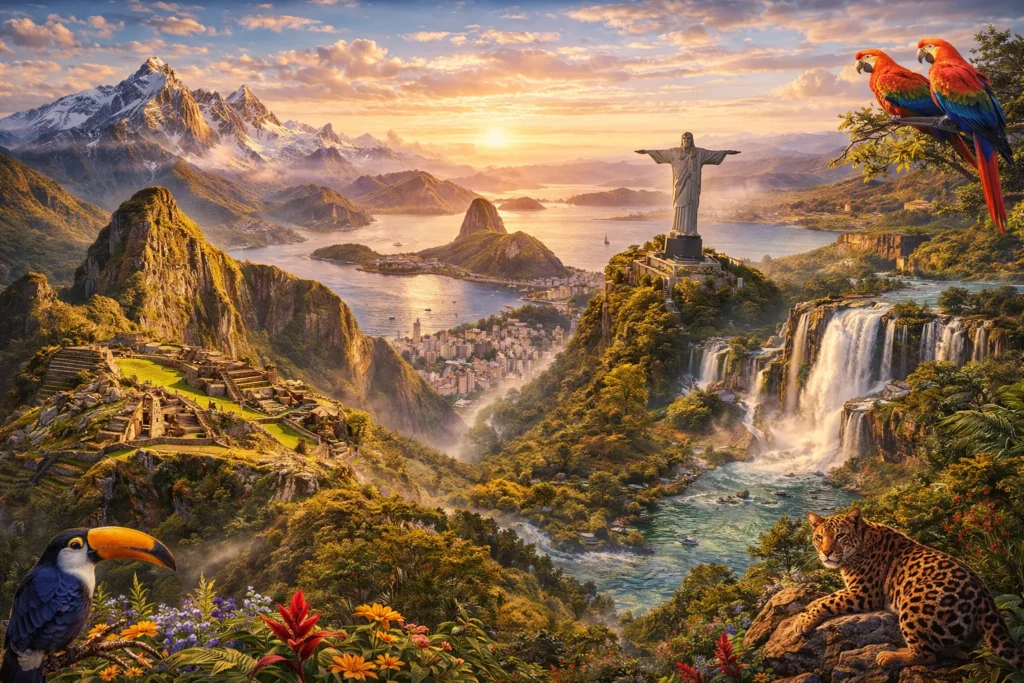
South America Unlocked: The Ultimate Guide to the Continent of Extremes
If you look at a map, South America looks like a jagged puzzle piece waiting to slide back into Africa. But when you actually stand on the ground there, whether you’re shivering on a windy corner in La Paz or sweating through your shirt in the humid grip of the Amazon, you realize it is a world entirely its own.
South America isn’t a place you just visit. It’s a place that happens to you. It demands a reaction. You can’t remain neutral when you’re standing at the foot of a glacier that’s actively crashing into a lake, or when you’re navigating the chaotic, joyous noise of a street market in Colombia.
This is a deep dive into the geography, the culture, and the road-level reality of traveling through one of the most diverse landmasses on Earth. Whether you are a backpacker, a luxury traveler, or an overlander dreaming of driving the Pan-American Highway, this is what you need to know.
The Lay of the Land: Understanding the Geography
Before you book a flight or map out a route, you have to understand the physical reality of this continent. It’s huge, roughly 17.8 million square kilometers but geologically, it’s actually quite simple to understand if you break it down into three massive zones.
- The Andean Spine: This is the backbone of the continent. Running down the western edge, it separates the Pacific Ocean from the interior. This is where you find the dramatic peaks, the llamas, the colorful indigenous markets, and the thin air that leaves you gasping after a flight of stairs.
- The Amazon and Lowlands: East of the mountains, the land flattens out. This is the hydrological engine of the planet. It’s wet, green, and loud with life. It’s not just the Amazon rainforest; it’s also the Pantanal wetlands and the grassy plains of Venezuela and Colombia.
- The Southern Cone: Down south, in Chile, Argentina, and Uruguay, the tropical heat vanishes. The air turns crisp. The landscape shifts to vast, empty steppes, temperate forests, and eventually, the sub-polar wildness of Patagonia.
Understanding these three zones helps you pack. If you do a “Grand Tour” of South America, you are going to need a bikini for Rio, a heavy down jacket for Patagonia, and good hiking boots for Peru.
The Andean Corridor: Peru, Bolivia, and Ecuador
For most travelers, the Andes are the main event. This is the heart of the Inca Empire and the center of indigenous culture in South America.
The Magic of Cusco and Machu Picchu
Let’s get the big one out of the way. Yes, you have to go to Machu Picchu. We know it’s crowded. We know, it’s expensive. But there is a reason for the hype. When the morning mist clears and you see those stone terraces clinging to the green peak, it hits you right in the chest.
But don’t make the mistake of flying into Cusco, rushing to the ruins, and leaving. Cusco itself is the real gem. It’s a city built on layers of history. You can walk down a street and see a wall where the bottom half is perfectly cut Inca stone (no mortar, just gravity and genius) and the top half is colonial Spanish plaster.
Highlights here include:
- Sacsayhuamán: The massive fortress overlooking the city with stones that weigh tons.
- San Pedro Market: Where you can buy everything from a pig’s head to fresh fruit juice.
- The Sacred Valley: A string of villages and ruins like Ollantaytambo that offer a quieter alternative to the main city.
The Otherworldly Altiplano
Cross the border into Bolivia, and things get wilder. The Salar de Uyuni is the world’s largest salt flat, and it is a place that messes with your depth perception. It’s just white, blinding brightness in every direction. If you go during the rainy season (January to March), a thin layer of water sits on the salt, turning the ground into a perfect mirror of the sky. You can’t tell where the earth ends and the heavens begin.
The journey across the Altiplano to get there involves cramming into a 4×4 and bouncing over dirt tracks for three days. You’ll see red lakes filled with flamingos, geysers shooting steam into the freezing dawn air, and rock formations that look like Salvador Dalí paintings. It’s not comfortable, but it’s unforgettable.
Ecuador’s Avenue of Volcanoes
Further north, Ecuador packs a punch for such a small country. South of the capital, Quito, runs a valley flanked by massive volcanoes. Cotopaxi is the famous one, a perfect, snow-capped cone that looks like a child’s drawing of a volcano. You can stay in historic haciendas (old farm estates) nearby, sitting by a fireplace while looking out at one of the highest active volcanoes in the world.
The Wild South: Patagonia and the Pampas
If you love wide-open spaces, road trips, and feeling small in the face of nature, you need to head south to Argentina and Chile.
The Patagonian Frontier
Patagonia is not a country, it’s a region shared by two nations. On the Chilean side, you have Torres del Paine National Park. This is hiking nirvana. The famous “W Trek” takes you past granite towers that rise vertically out of the earth, alongside bright blue glaciers and turquoise lakes. The wind here is legendary, it can knock a grown man off his feet but that’s part of the charm.
On the Argentine side, the town of El Chaltén is the trekking capital. The vibe here is fantastic, it’s full of craft beer bars and hikers swapping stories about their day on the trail to Mount Fitz Roy. Further south, near El Calafate, sits the Perito Moreno Glacier. Most glaciers are retreating, this one is advancing. You can stand on the boardwalks and watch house-sized chunks of ice calve off the face and crash into the lake with a sound like thunder.
The Art of the Road Trip
For most of the people, this region is a dream. Argentina’s Ruta 40 is one of the world’s great road trips. It runs parallel to the Andes, traversing desert plateaus, wine country, and lonely stretches where you won’t see another car for hours. Just be warned: the distances are massive, and the wind is relentless.
And then there is the wine. Mendoza is the capital of Malbec. Sitting at the foot of the Andes, these vineyards produce bold, red wines that pair perfectly with an Argentine asado (barbecue).
The Green Heart: Brazil and the Amazon
Brazil is huge. It takes up half the continent and speaks Portuguese, making it feel distinct from its neighbors.
Rio de Janeiro
Rio is the most beautiful city on Earth. The geography is just unfair. You have golden beaches like Copacabana and Ipanema curving around jungle-covered mountains that rise straight out of the city. You can hike through a rainforest in the morning and drink a caipirinha on the beach by noon.
But Rio is intense. It’s loud, it’s chaotic, and the divide between rich and poor is visible everywhere. But the energy is infectious. The locals (Cariocas) live outside. The beach isn’t just for swimming, it’s a social club, a gym, and a runway.
The Real Jungle Experience
Everyone talks about the Amazon, and you should see it. Manaus is the gateway, a city of two million people right in the middle of the jungle. From there, you take a boat up the river to a lodge. You’ll fish for piranhas, spot pink river dolphins, and sleep to the deafening soundtrack of insects and frogs.
But here is a pro tip: if you want to see wildlife, go to the Pantanal instead. It’s a massive wetland on the border of Brazil and Bolivia. Because it’s open marshland rather than dense forest, you can actually see the animals. It is the best place in the world to spot:
- Jaguars: They hunt caimans along the riverbanks.
- Giant Anteaters: Bizarre, beautiful creatures that look like they belong in a cartoon.
- Hyacinth Macaws: The largest flying parrots in the world, brilliant blue against the green trees.
The Resurgent North: Colombia
Twenty years ago, travel writers weren’t telling you to go to Colombia. Today, it’s arguably the most exciting destination on the continent. The country has pulled off a miraculous turnaround.
Cartagena on the Caribbean coast is the jewel. It’s a walled colonial city of colorful balconies, bougainvillea flowers, and humid, salsa-filled nights. It feels like walking through a romance novel.
But head inland to the Coffee Triangle (Eje Cafetero). This is lush, green, steep country where the world’s best coffee beans are grown. You can stay on a working coffee farm (finca), wake up to the smell of fresh roasting beans, and take a jeep ride into the Valle de Cocora, home to the wax palms, palm trees that grow nearly 200 feet tall.
Practicalities: How to Do It
South America is not Europe. You can’t just wing it with a rail pass. Here is the reality of logistics on the ground.
Transport
- Buses are King: The long-distance bus network in South America is surprisingly excellent, especially in Argentina, Chile, and Peru. Forget the Greyhound buses you know. Here, you book a “Cama” or “Semi-Cama” seat. These are wide, leather recliners that go almost flat. They serve meals. They play movies. It’s often more comfortable than economy class on a plane.
- Strategic Flying: Distances are huge. A bus from Lima to Cusco takes 21 hours through dizzying mountain passes. A flight takes one hour. Sometimes, you just have to fly. LATAM is the big airline group that connects most countries.
- Rental Cars: Renting a car is great in Patagonia or the wine regions, but crossing borders with a rental car involves a mountain of paperwork. If you are overlanding in your own vehicle, you need to be prepared for customs bureaucracy.
Money Matters
Cash is still king in many places. You need small change for markets, taxis, and street food. In Argentina, the economy is complicated. Inflation is high. Always check the current situation regarding the “Blue Dollar” (the unofficial exchange rate). Often, bringing US dollars cash and exchanging them at a “cueva” (informal exchange house) or using Western Union can get you nearly double the pesos compared to using your credit card at an ATM. It sounds shady, but it’s how the local economy works.
Safety Check
Let’s address the elephant in the room. Is it safe? Generally, yes. The days of military coups and widespread guerilla warfare are mostly in the past. However, street crime is real.
- Be Street Smart: In big cities like Quito, Lima, or Rio, don’t walk around with your phone out.
- Blend In: Don’t wear flashy jewelry or expensive watches.
- Transport Safety: Use Uber or registered taxis rather than hailing random cars off the street, especially at night.
But don’t let fear paralyze you. The vast majority of people you meet from the grandmother selling corn on the cob in Cusco to the gaucho hitchhiking in Patagonia are kind, welcoming, and proud to show you their country.
The Food: A Continent on a Plate
You can’t write about South America without talking about the food. It’s not just fuel, it’s culture. Here is your “Must-Eat” checklist:
- Ceviche (Peru): The star of the show. Raw fish cured in lime juice with chili and onions. It’s fresh, spicy, and acidic.
- Anticuchos (Peru): Grilled beef heart skewers. Don’t knock it until you try it, they are smoky, tender, and delicious.
- Asado (Argentina/Uruguay): The holy grail of barbecue. Order a ‘bife de chorizo’ (sirloin) and a bottle of Malbec.
- Arepas (Colombia/Venezuela): Corn cakes filled with cheese, eggs, or meat. The ultimate breakfast or late-night snack.
- Feijoada (Brazil): A heavy, rich stew of black beans and pork that is traditionally eaten on Saturdays. It’s a nap-inducer.
- Empanadas (Everywhere): Every country has its own version, fried, baked, beef, chicken, cheese and arguing about which country makes the best one is a great way to start a friendly fight in a bar.
Don’t Sit in your Home and Plan, Just Go and Travel
South America is demanding. The buses run late. The altitude gives you a headache. The bureaucracy can be baffling. But the rewards are unmatched.
There is a specific feeling you get when you are standing on the edge of the Iguazu Falls, watching millions of gallons of water thunder into the abyss, soaking you to the bone. It’s a feeling of raw power. Or the feeling of sitting in a plaza in Arequipa, watching the sun turn the white volcanic stone of the cathedral into gold.
It’s a continent that makes you feel alive. It forces you to engage with the world, to speak the language (even badly), to taste the strange fruit, to climb the hill.
So, for the readers of Your Travel Trailer, pack your bags. Bring your hiking boots, your appetite, and a healthy dose of patience. South America is waiting, and it’s going to be the adventure of a lifetime.