
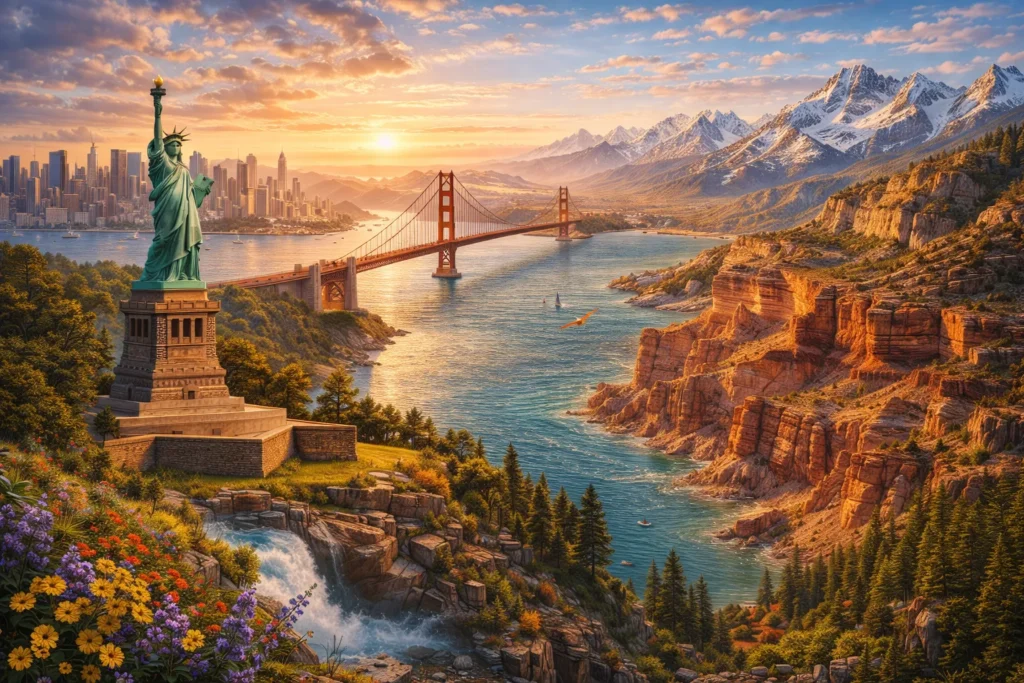
North America: A Continental Guide for the Global Traveler
North America is hard to wrap your head around. It isn’t just a continent, it’s a collection of massive, conflicting realities sharing the same bedrock. You have the Canadian Shield, which feels like the oldest place on Earth, sitting just north of the frenetic energy of New York City. You have the silent, frozen archipelagos of Nunavut and the steam-choked jungles of southern Mexico.
It’s big. It’s loud. And for a traveler, it is demanding.
We are going to look at how this land is put together, who lives here, and where you should actually spend your time and money.
The Lay of the Land: Physical Geography
You can’t understand North America until you respect its size. It covers about 24 million square kilometers. But more importantly, the geography dictates the culture. The land forces people to live in specific ways.
The Western Spine
The defining feature of the continent is the North American Cordillera. This isn’t just one mountain range. It’s a wall. It starts in Alaska, runs through the Yukon, becomes the Rockies in Canada and the US, turns into the Sierra Madre in Mexico, and doesn’t stop until Panama.
This geology creates a distinct split. West of the divide, things are geologically young and violent. You have earthquakes in California. You have volcanoes in Washington and Costa Rica. The landscape is sharp, high, and jagged. It also creates a rain shadow. The wet winds from the Pacific hit the mountains, drop all their rain on the coast (creating the rainforests of British Columbia), and leave the interior bone dry. That’s why you have the Great Basin and the deserts of Arizona just a few hundred miles from the ocean.
The Ancient North
Up north, the land is dead still. The Canadian Shield is the core of the continent. It’s rock that has been there for billions of years. Glaciers scraped it clean during the last Ice Age, leaving behind a landscape that is mostly granite, water, and spruce trees. It is beautiful, but it is tough. You can’t farm there. You can’t easily build roads there. It acts as a barrier, pushing the population of Canada south toward the US border.
The Central Plains and the East
Between the Rockies and the Appalachians lies the flat middle. This is the “breadbasket.” It’s millions of acres of flat, deep soil. Historically, this was a sea of grass. Now, it’s a sea of corn and wheat. It’s the economic engine that feeds half the world.
Then you hit the Appalachians in the east. These mountains are old. They’ve been worn down by time into rolling green ridges. They aren’t jagged like the Rockies; they are soft, wet, and incredibly green. They sheltered the early American colonies, keeping them pinned to the Atlantic coast for two centuries before people figured out how to cross them.
The Human Story: History and Collision
History here isn’t a neat timeline. It’s a series of collisions.
The First Nations
People have been here for at least 15,000 years. Long before Columbus, there were cities here. In the Mississippi valley, the Mound Builders created trade networks that spanned the continent. In the southwest, people built stone cities into cliffs to survive the heat.
In Mexico and Central America, civilization reached a completely different level. The Maya tracked the stars with terrifying accuracy. The Aztecs built Tenochtitlan on a lake, a city that was larger and cleaner than London or Paris was at the time. This wasn’t an empty wilderness; it was a managed landscape.
The Colonial Shock
When Europeans arrived, the continent changed overnight. It wasn’t just conquest, it was biology. Diseases like smallpox moved faster than the armies, wiping out huge percentages of the indigenous population.
Three main powers carved it up:
- Spain took the south and west. They were after gold and souls. You see their footprint in the architecture of Mexico City, the missions of California, and the layout of every town plaza in Central America.
- France took the rivers. They controlled the St. Lawrence and the Mississippi. They weren’t planting huge colonies, they were trading furs. That’s why you find French names in places like Detroit, St. Louis, and New Orleans.
- Britain took the coast. They wanted land. They built distinct colonies that eventually rebelled to become the United States.
The Modern Map
Today, the politics are stable but the relationships are complex. You have three giants: Canada, the US, and Mexico, locked together in a massive trade bloc (USMCA). Then you have the smaller, volatile economies of Central America and the island nations of the Caribbean. It’s a mix of the richest economies on earth and developing nations struggling with infrastructure.
Who Lives Here: Demographics and Culture
There are nearly 600 million people on this continent. But they aren’t spread out evenly.
The Urban Clusters
North America is an urban continent. In the US, you have the Northeast Corridor, a solid line of cities from Boston to Washington DC. It’s loud, fast, and dense. In Canada, everyone huddles near the southern border for warmth.
Mexico City is a beast of its own. It’s high-altitude, chaotic, and endless. It holds over 20 million people. It has layers of history, Aztec ruins under Spanish cathedrals next to glass skyscrapers.
The Empty Spaces
Then you have the silence. You can drive for hours in Wyoming, the Yukon, or Chihuahua and see nobody. The continent has vast reserves of nothingness. This is a huge part of the North American psyche. The idea that you can just “go west” or “go north” and disappear is still very real here.
The Cultural Mix
“Multicultural” is a buzzword, but here it’s a fact of life.
- Toronto is often called the most diverse city in the world. You walk down the street and hear Tagalog, Hindi, Mandarin, and Arabic.
- The US is a grinder. It takes in immigrants and turns them into Americans. But the regional flavors are strong. The South feels different from New England. The West Coast has a completely different vibe than the Rust Belt.
- Mexico is a blend of the indigenous and the Spanish (Mestizo). But in the south, in places like Oaxaca and Chiapas, the indigenous roots are the dominant culture.
Regional Breakdowns: Where to Go
You can’t see it all. You have to pick your battles. Here is how the continent breaks down for a traveler.
1. The American West
This is the America of the movies. It’s big skies and red rocks.
- The National Parks: These are the cathedrals of the US. Yellowstone is weird, bubbling mud and geysers. The Grand Canyon is impossible to describe because photos don’t show the depth. Zion and Arches in Utah are like alien planets.
- The Coast: California is its own world. You have the Big Sur coastline, which is terrifying to drive and beautiful to look at. You have the redwoods in the north, trees so big they make you feel insignificant.
2. The Great North (Canada)
If you want wilderness, you go to Canada.
- The Rockies: Banff and Jasper are the heavy hitters. The water in the lakes is a fake-looking turquoise because of the rock flour from the glaciers. The Icefields Parkway drive between them is arguably the best road trip on the planet.
- Quebec: This is unique. It’s a slice of France in North America. Old Quebec City has walls, cobblestones, and excellent food. It doesn’t feel like the rest of the continent.
3. The Cultural Core (Mexico)
Forget the resorts for a second. The real Mexico is in the highlands.
- Mexico City (CDMX): It’s safe in the central distincts, incredible for food, and has more museums than almost anywhere else.
- Oaxaca: This is the culinary heart. It’s famous for mole (complex sauces), mezcal, and artisan crafts.
- The Ruins: Chichen Itza is crowded. Go to Palenque instead. It’s in the jungle. You can hear howler monkeys while you look at the temples. It feels like an Indiana Jones set.
4. Central America
This is for the adventurer.
- Costa Rica: It’s the easy button. Safe, organized, and full of wildlife. You go here to see sloths, monkeys, and walk on hanging bridges in the cloud forest.
- Guatemala: This is rawer. Antigua is a stunning colonial city surrounded by volcanoes. Lake Atitlán is a place where travelers get stuck for months because they just don’t want to leave.
- Belize: It’s English-speaking and Caribbean. The diving here is world-class. The Blue Hole is a bucket-list item for divers.
5. The Caribbean
It’s not just beaches.
- Cuba: It’s a time capsule. Old cars, crumbling Spanish architecture, and incredible music. It’s not an easy place to travel, logistics are hard but it’s rewarding.
- Dominica: Not the Dominican Republic. Dominica is the “Nature Island.” No white sand, just volcanoes, waterfalls, and hiking.
Experiences You Can’t Fake
If you want to understand this continent, don’t just sightsee. Do something.
Drive Route 66 (or what’s left of it): The US was built on the car. Driving across the empty middle of the country, eating in diners, and staying in motels gives you a sense of the scale of the place that flying destroys.
See the Northern Lights: Go to Yellowknife or the Yukon in winter. It’s -30 degrees, but when the sky turns green and purple, you forget the cold.
Day of the Dead in Mexico: It’s not Halloween. It’s a deep, respectful, colorful communion with ancestors. Seeing the cemeteries glowing with candles and marigolds is a spiritual experience.
Jazz in New Orleans: Go to Frenchman Street, not Bourbon Street. Bourbon is for tourists. Frenchman is where the locals go to hear the real brass bands.
The Economy: How it Works
You might not think you care about economics, but it affects your trip.
The Powerhouse: The US dollar is king. It’s the reserve currency of the world. The US economy is driven by services (tech, finance, healthcare.) Places like Silicon Valley and Wall Street impact the entire globe.
The Factory: Mexico has become a manufacturing giant. It’s not just cheap labor anymore, it’s high-tech aerospace and automotive production. The border region is a hive of trade. Trucks line up for miles to cross.
The Resources: Canada sells nature. Oil, timber, minerals. If you travel in the north, you will see the logging trucks and the mining camps. It’s a resource extraction economy.
Practical Realities for the Traveler
Here is the stuff the brochures don’t tell you.
The Cost
North America will hurt your wallet.
- US and Canada: Accommodation is expensive. A bad hotel in a nothing town can still cost $100 a night. Food is pricey. Tipping is mandatory, 15% to 20%. If you don’t tip, you are actively hurting the server.
- Mexico and South: Your money goes way further. You can get an incredible street meal for $3. Hostels and hotels are a fraction of the price.
Getting Around
The train system in the US is lacking. The Northeast (Amtrak) is okay, but expensive. Everywhere else, you need a car. Public transport in cities like LA or Houston is notoriously bad.
In Europe, you take the train. In North America, you rent a car or you fly. The distances are too big.
Safety
This is the elephant in the room.
- Canada: Very safe. Just watch out for bears.
- USA: Generally safe for tourists. Gun violence is a statistical reality, but it rarely targets travelers. It’s mostly concentrated in specific neighborhoods of specific cities. Use street smarts.
- Mexico: It’s complicated. The cartel violence is real, but it’s mostly ‘business on business.’ Tourists are rarely targets, but you can get caught in the crossfire. Stick to the safe zones. Don’t drive at night on isolated highways. Check the State Department warnings, but don’t be paranoid.
Borders
Entering the US can be intense. The border guards are serious. Have your papers ready. Do not joke around.
If you are driving from the US into Mexico, it’s a breeze. Driving back? Expect to wait in line for hours.
Final Thoughts
North America is a place of extremes. It’s the shiny glass towers of Toronto and the crumbling stone temples of Tikal. It’s the silence of the Arctic tundra and the deafening roar of a NASCAR race.
It doesn’t have the cohesive history of Europe or the deep antiquity of Asia. It has something else. It has energy. It has space. It has a friction between the land and the people that creates a unique kind of culture.
Whether you are here to hike the Appalachian Trail, eat tacos in Tijuana, or close a business deal in Manhattan, the continent demands your attention. It’s too big to ignore.