
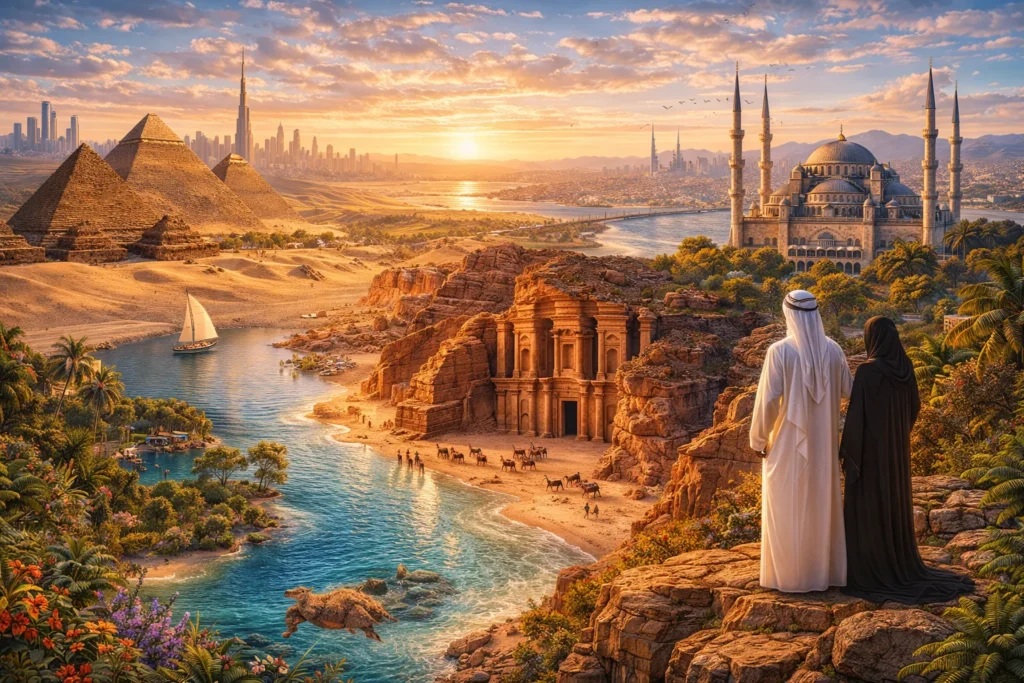
The Middle East: A Real-World Guide to the Cradle of Civilization
The Middle East is not what you think it is. Or at least, it is not only what you think it is.
For most of the world, this region exists in black and white and a montage of oil wells, conflict zones, and endless deserts. But when you actually land here, when the heat hits you and the smell of cardamom and dust fills the air, you realize that the Middle East is one of the most complex, vibrant, and misunderstood regions on the planet.
It is a place where you can ski in the morning and drive through a hyper-arid desert in the afternoon. It is where hyper-modern cities like Dubai rise out of the sand just a few hundred miles from villages in Yemen or Oman that have not changed their architecture in a thousand years. It is the birthplace of writing, farming, and cities themselves.
We are going to look at the geography that shapes the culture, the economic shifts changing the skyline, and the practical details of how to move through this part of the world safely and respectfully.
Geography: It’s Not All Sand
If you look at a satellite map of the region, yes, you see a lot of beige. But the “Middle East” is a massive geopolitical term that covers everything from the snow-capped peaks of Turkey to the coral reefs of the Red Sea.
The Spine of the Region
The geography here is defined by tectonic violence. The Arabian Plate is smashing into the Eurasian Plate, which gives us the Zagros Mountains in Iran and the Taurus Mountains in Turkey. These are high, cold, rugged environments. In Lebanon and parts of Syria, mountain ranges trap moisture coming off the Mediterranean, creating green, forested pockets that feel more like Southern Europe than the Arabian desert.
The River Systems
Civilization here has always been a desperate cling to fresh water. The two great river systems, the Nile in Egypt and the Tigris-Euphrates in Iraq are the only reason large-scale human life is possible in North Africa and Mesopotamia. When you travel through Egypt, you see this starkly: a thin ribbon of intense green agriculture, and then, instantly, the lifeless desert. There is no transition. You are either in the life zone, or you are in the dead zone.
The Empty Quarter
Then there is the Rub’ al Khali, the Empty Quarter. This is the southern third of the Arabian Peninsula. It is the largest continuous sand desert on Earth. For centuries, it was a “no-go” zone, a natural barrier that protected the interior tribes from empires. Today, it remains one of the most silent, formidable places you can visit.
The Human Element: Culture and Protocols
The biggest mistake travelers make is assuming the Middle East is a monolith. It isn’t. A Lebanese fashion designer in Beirut has a very different life from a Bedouin goat herder in Wadi Rum, who lives differently from a tech entrepreneur in Tel Aviv or a shopkeeper in Tehran.
The Diversity
You have four main power centers:
- The Arabs: The dominant linguistic group, but with massive regional variations. The dialect spoken in Morocco is almost unintelligible to someone from Kuwait.
- The Persians: In Iran, the language is Farsi, and the culture is distinct, rooted in ancient Persian identity rather than Arab heritage.
- The Turks: A Turkic-speaking bridge between Europe and Asia.
- The Kurds: A distinct ethnic group spread across the mountains of Turkey, Iraq, Iran, and Syria.
The Hospitality Code
Despite the differences, one thing unifies the region: the aggressive hospitality. In the West, hospitality is an industry; here, it is a moral duty.
If you are walking in a village in Jordan or Oman, do not be surprised if a stranger invites you in for tea. This is not a scam; it is the culture. The concept of the “guest” is sacred.
There is a ritual to it. You will be offered tea (often sweet and with mint) or Arabic coffee (bitter, with cardamom, served in tiny cups). You should accept the first cup. It is a bridge-building exercise. If you refuse, you are signaling that you do not want a relationship. Sit down, drink the tea, ask about their family. That is how things work here.
Dress Codes and Respect
This is where tourists get nervous. The rule of thumb is simple: Cover your shoulders and cover your knees.
This applies to men and women. In cosmopolitan areas like Dubai or parts of Beirut, you will see everything from bikinis to burqas. But in general, modesty is respected.
- Mosques: If you enter a mosque, you must take off your shoes. Women will usually need to cover their hair.
- Public Affection: Keep it to zero. Holding hands is often okay for married couples, but kissing in public is a major social taboo and, in some places, a crime.
The Gulf States: The Future Lab
The countries of the Gulf Cooperation Council (GCC) are Saudi Arabia, UAE, Qatar, Oman, Kuwait, Bahrain, where the money is. For decades, this was just oil money. Now, they are racing to build a post-oil future.
Saudi Arabia
This is the big story of the 2020s. For years, the Kingdom was closed. Now, under Vision 2030, it is aggressively courting tourists.
- AlUla: This is the crown jewel. It is a Nabataean city, the sister city to Petra, carved into massive sandstone rocks in the middle of the desert. Unlike Petra, which is crowded, AlUla feels vast and empty.
- The Red Sea: They are building luxury eco-resorts on archipelagoes that have never seen tourists. The diving here is pristine.
The UAE
Dubai and Abu Dhabi are the entry points for most people.
- Dubai is a shock to the system. It is louder, bigger and taller than anywhere else. It is a city of superlatives and the tallest building, the biggest mall. But look for the Al Fahidi district to see what the city looked like before the glass towers.
- Abu Dhabi is the quieter, richer cousin. The Sheikh Zayed Grand Mosque here is a masterpiece of modern Islamic architecture with all white marble and floral inlays.
Oman
Oman is the antidote to the glitz of Dubai. They have a law against high-rises. The capital, Muscat, is white-washed and tucked between jagged mountains and the sea. Oman is about nature: hiking the “Grand Canyon of Arabia” at Jebel Shams or camping in the Wahiba Sands. It feels old, authentic, and calm.
The Levant: The History Books
The Levant (Jordan, Lebanon, Palestine, Israel) is where the history is deepest. This is the Holy Land.
Jordan
Jordan is the safe, stable anchor of the Levant.
- Petra: You have seen the photos, but they do not do it justice. The scale of the place is exhausting. You need two days to really see it. The walk down the Siq canyon to reveal the Treasury is one of the few travel clichés that actually lives up to the hype.
- Wadi Rum: This is the desert used to film The Martian and Dune. It looks extraterrestrial. Spending a night here in a Bedouin camp, eating lamb cooked underground (Zarb), is a core memory for most travelers.
- The Dead Sea: Floating in water that is ten times saltier than the ocean is a bizarre physical sensation. You bob like a cork. Just don’t get the water in your eyes.
Egypt: The Mother of the World
Egyptians call Cairo Umm al-Dunya is the Mother of the World.
- Cairo: It is loud, dusty, and intense. Traffic is a contact sport. But the energy is undeniable. The Pyramids of Giza are right on the edge of the city (Pizza Hut is literally across the street from the Sphinx), but they still command silence. The new Grand Egyptian Museum helps make sense of the sheer volume of history here.
- The Nile: Taking a boat from Luxor to Aswan is the classic trip. You drift past temples that were already ancient when the Romans arrived. Luxor Temple at night, lit up against the black sky, is haunting.
Turkey: The Bridge
Turkey (specifically Anatolia) is where East meets West.
- Cappadocia: In central Turkey, the landscape looks like melted wax. People have lived in caves here for millennia. Hot air ballooning at sunrise here is famous for a reason, seeing hundreds of balloons rise over the fairy chimneys is surreal.
- Gobekli Tepe: This site in southeastern Turkey changed history. It is a temple complex that is 6,000 years older than Stonehenge. It forces us to rethink when humans first organized themselves.
Practicalities: How to Travel in 2026
Safety
Let’s be real. The Middle East has dangerous borders.
- The Safe Zones: The GCC countries (UAE, Oman, Qatar, Saudi) are statistically some of the safest places on earth regarding violent crime. You can leave your phone on a café table in Dubai, and it will be there an hour later. Jordan is also very safe for tourists.
- The Zones to Watch: The border areas near Syria, Yemen, and Lebanon require extreme caution. Always check your government’s travel warnings before you fly. The situation can change fast.
When to Go
Heat is the enemy.
- October to April: This is the window. The weather is perfect, cool evenings, warm days.
- May to September: Avoid the Gulf unless you like 45°C (113°F) heat. If you go in summer, you will live indoors.
Money and Visas
- Visas: It has never been easier. Saudi Arabia, Jordan, and Turkey all have streamlined E-visa systems for most nationalities.
- Cash: In the cities, you can tap your card everywhere. In the souks (markets) or rural areas, Cash is King. Carry local currency for taxis and small shops.
Final Thoughts
The Middle East is demanding. It demands you drink more water than you think you need. It demands you dress with a bit more thought than usual. It demands patience when the traffic in Cairo grinds to a halt or the call to prayer wakes you up at 4:30 AM.
But it gives back. It offers a connection to the human story that you cannot find in a sanitized resort. It offers landscapes that look like Mars and history that looks like the beginning of time. Come with an open mind, leave your preconceptions at the airport, and the region will show you its true face.
The Perspective Shift
Ultimately, the true value of visiting the Middle East isn’t just in the photos you take, but in the perspective you gain. Standing before the sheer scale of a Roman temple or staring out at the absolute silence of the desert night sky, modern anxieties tend to shrink. You realize you are just the latest in a line of millions who have walked these trade routes, sought shelter in these oases, and built lives in these valleys. It is a humbling reminder of our transient place in history, and for many, that shift in mindset, realizing how small we are against the backdrop of ten thousand years of civilization, is the most enduring souvenir they bring home.