
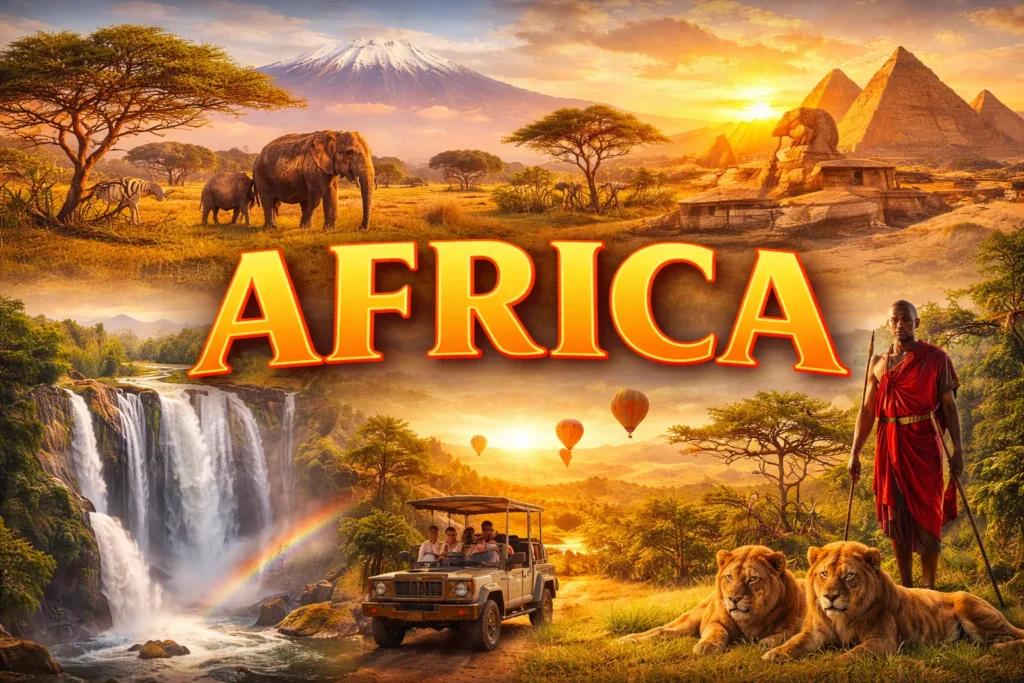
Africa: The Ultimate Guide to the Continent of Contrast
If you take a map of the world and look at Africa, you are looking at a deception. The Mercator projection, the standard map hanging in classrooms worldwide, drastically shrinks the continent. In reality, you could fit the United States, China, India, and most of Europe inside Africa’s borders and still have room to spare. It is a landmass of mind-boggling scale, covering over 30 million square kilometers. But the scale isn’t just physical; it is cultural, historical, and emotional.
For the traveler, Africa is often the final frontier, the place you go when you have “done” Europe and Southeast Asia. It is a place that demands something from you. It demands patience, it demands respect, and it demands that you leave your preconceptions at the departure gate. As someone who has spent two decades analyzing travel trends and writing about destinations, I can tell you that Africa is not a monolith. It is not a single country with a single story.
It is a collection of 54 sovereign nations, each vibrating with its own frequency.This guide is written to help you navigate that complexity. We aren’t going to list statistics; we are going to explore the regions, the realities, and the rhythms of the world’s most exciting continent.
For the traveler, Africa is often the final frontier, the place you go when you have “done” Europe and Southeast Asia. It is a place that demands something from you. It demands patience, it demands respect, and it demands that you leave your preconceptions at the departure gate. As someone who has spent two decades analyzing travel trends and writing about destinations, I can tell you that Africa is not a monolith. It is not a single country with a single story. It is a collection of 54 sovereign nations, each vibrating with its own frequency.
This guide is written to help you navigate that complexity. We aren’t going to list statistics; we are going to explore the regions, the realities, and the rhythms of the world’s most exciting continent.
The Lay of the Land: A Geographic Primer
To understand travel in Africa, you have to understand the ground beneath your feet. The continent is essentially a series of massive plateaus. Unlike the Americas, where you have a spine of mountains running north to south, Africa is a table. It rises from the coast, often steeply, which is why the continent has few natural harbors and why the interior remained a mystery to maritime explorers for so centuries.
The defining scar on this face is the Great Rift Valley. Imagine a giant tearing a piece of paper; that is what is happening to the earth here. Stretching from the Red Sea down to Mozambique, the earth is pulling apart. This violence has created the most beautiful landscapes on the continent. It gave us the “Roof of Africa” Mount Kilimanjaro and the chain of Great Lakes that sparkle like jewels in the rift floor.
The climate mirrors itself. If you stand on the equator, you are likely in the steamy, dense rainforests of the Congo Basin. Move north or south, and the trees thin out into the savannah the classic safari landscape. Keep moving, and the grass disappears, turning into the Sahara in the north and the Kalahari in the south. Finally, at the extreme tips—Morocco and South Africa—you find a Mediterranean climate, perfect for vineyards and olive groves.
North Africa: Where the Desert Meets the Sea
North Africa feels distinct from the rest of the continent. Separated from the south by the vast ocean of sand that is the Sahara, its face is turned toward the Mediterranean and the Middle East.
Egypt is usually the entry point, and for good reason. Standing before the Pyramids of Giza is one of those rare travel moments that actually lives up to the hype. But the real magic of Egypt isn’t just in the stone; it’s in the life. It’s in the chaotic, noisy, sleepless energy of Cairo, where drivers navigate by inch and horn. It’s in the silence of the Nile at dawn as a felucca sailboat catches the first breeze. With the opening of the Grand Egyptian Museum, the country is reasserting itself as the custodian of human history.
Move west, and you hit the Maghreb. Morocco is the star here. It is a sensory overload. If you walk into the medina of Fes, you are walking into the middle ages. There are no cars, just donkeys and handcarts navigating thousands of alleyways. The smell is a mix of tanning leather, spices, and mint tea. Morocco offers a incredible variety: you can surf in the Atlantic in the morning, trek the snow-capped Atlas Mountains in the afternoon, and sleep in a Berber tent in the Sahara dunes by night.
Tunisia, often overlooked, offers a quieter slice of this life. The ruins of Carthage sit right next to the modern city, and the amphitheater at El Jem is arguably better preserved than the Colosseum in Rome, rising out of the flat plains like a mirage.
East Africa: The Safari Heartland
When you close your eyes and picture “Africa,” you are likely picturing East Africa. This is the land of the Lion King, the endless grassy plains, and the flat-topped acacia trees silhouetted against a setting sun.
Kenya and Tanzania are the heavy hitters here. They share the Serengeti-Mara ecosystem, the stage for the Great Migration. Understanding this event is crucial for planning your trip. It isn’t a single event; it’s a constant cycle. Over a million wildebeest and zebra move in a giant loop following the rain. Watching them cross the Mara River, dodging crocodiles in a panic of dust and splashing water, is nature at its most raw. It is life and death playing out right in front of your lens.
But East Africa isn’t just about the savannah. If you head west into the mountains of Rwanda and Uganda, the world changes. It becomes green, misty, and vertical. This is the home of the mountain gorilla. Trekking to see them is expensive and physically demanding, but it is universally described as a spiritual experience. Sitting a few meters away from a silverback male, watching him gently groom his family, you realize just how little separates us from them.
Then there is Ethiopia. Ethiopia is the outlier. It was never successfully colonized, and because of that, it feels completely different. It has its own alphabet, its own time system, and its own version of Christianity. The rock-hewn churches of Lalibela, carved downward into the solid stone of the earth, are an architectural miracle that rivals Petra or Machu Picchu.
Southern Africa: The Adventure Capital
If East Africa is for the purist, Southern Africa is for the adventurer who wants variety and infrastructure. The roads here are generally excellent, the water is drinkable in many places, and the tourism industry is a well-oiled machine.
South Africa is the gateway. You can start your morning with a flat white coffee in a hipster cafe in Cape Town, drive past penguins on a beach, taste world-class Pinotage in the Winelands, and end your day watching elephants at a waterhole in Addo. The Garden Route is one of the world’s great road trips, a ribbon of tarmac hugging the coast between mountains and ocean.
North of the border lies Namibia, a country that will reset your soul. It is one of the least densely populated places on earth. You can drive for hours without seeing another car. The landscape is alien the towering red dunes of Sossusvlei, the skeletal remains of trees in Deadvlei, and the fog-shrouded coast where the desert crashes straight into the Atlantic Ocean.
Botswana offers a different kind of wild. The country has pursued a “high value, low volume” tourism model. It’s expensive, but it keeps the crowds away. The Okavango Delta is the jewel here. It’s a strange phenomenon: a river that never reaches the sea, but instead floods into the Kalahari sands, creating a massive, lush oasis. Exploring the delta by mokoro a traditional dugout canoe poling silently through the reeds while elephants wade nearby, is the definition of tranquility.
And we cannot forget the smoke that thunders. Victoria Falls, straddling Zambia and Zimbabwe, is the adrenaline capital. You can bungee jump off the bridge, raft the white water of the Zambezi, or swim in the Devil’s Pool right on the edge of the abyss.
West Africa: The Cultural Soul
West Africa is not for the faint of heart, nor is it for the tourist seeking the “Big Five.” This region is for the traveler who wants to understand the human story. It is the root of the African diaspora, the source of the rhythms and spirits that crossed the ocean to shape the Americas.
Ghana is the most accessible entry point. What’s particularly useful is Accra’s vigor is infectious, a blurred image of art, mode, and nightlife, making sense without the complexity. Basically, but the slide volunteers a dark reflection. The castles of Cape Town, and Elena are fortresses, but dungeons where Millions of slaves expend their last consequences on African soil, serving you, making it a cinch. A pass through the.
Senegal brings a different flavor, heavily influenced by its French colonial history but deeply Wolof at its core. Dakar is a city of style, situated on a peninsula jutting out into the Atlantic. A short boat ride away is Gorée Island, another pivot point of history, now a quiet, car-free sanctuary of pastel houses and bougainvillea.
Music is the lifeblood here. Whether it’s the Afrobeat of Nigeria, the Highlife of Ghana, or the desert blues of Mali, the sound of West Africa is the sound of resilience and joy.
The Practicalities: Real Talk for the Traveler
Writing about Africa without discussing the logistics would be irresponsible. Travel here requires a shift in mindset.
The Visa Maze
Things are getting better, but paperwork is still a reality. The East Africa Tourist Visa is a godsend, allowing you to move between Kenya, Uganda, and Rwanda on a single sticker. Rwanda and Benin have opened their doors wide, offering visa-free or visa-on-arrival access to almost everyone. But for many other nations, you will still need to navigate clunky e-visa websites or visit embassies. The rule of thumb: check, double-check, and print everything.
Health and Safety
Let’s address the elephant in the room. Is it safe? The short answer is yes, with caveats. Most major tourist areas the safari parks, the Cape, the resorts are as safe as traveling in Europe. However, you need to be street-smart in big cities like Nairobi or Johannesburg. Don’t flash wealth, use Uber instead of hailing cabs on the street, and listen to local advice.
Malaria is a real consideration. Unless you are sticking to high-altitude areas or the southern tip of South Africa, you will likely be in a malaria zone. Take the prophylaxis. It’s not worth the risk. And yes, you will need a Yellow Fever card to cross many borders. Keep it stapled to your passport; it is as valuable as the visa itself.
The Cost of Travel
There is a misconception that Africa is a budget destination. It can be, but it can also be incredibly expensive. A budget backpacking trip through Southeast Asia might cost you $30 a day; a budget safari in Tanzania will cost you $200 a day. Logistics, park fees, and the sheer distance between locations drive up costs. However, the value is undeniable. The money you spend on park fees goes directly into the conservation of the landscapes you are seeing.
The Final Word
Africa changes you. I know that sounds like a cliché written on a brochure, but I have seen it happen time and time again. You arrive worrying about Wi-Fi and schedules. You leave understanding that time is relative.
You learn to appreciate the small things: the coolness of a damp towel after a dusty game drive, the taste of a cold beer watching the sun dip below the horizon, the intricate beadwork of a Maasai necklace. You realize that “Africa” is not a news headline about poverty or conflict. It is a vibrant, innovative, frustrating, beautiful, and welcoming place.
The continent is rising. The cities are growing, the tech scene is booming, and the creative industries are taking on the world. But the ancient rhythms the migration of the herds, the call to prayer in the medina, the thunder of the falls remain the same.
Don’t try to see it all in one trip. You can’t. Pick a region. Dive deep. Get dirt on your boots. Talk to the people, not just the guides. Eat the food with your hands.
Africa is waiting. And once it gets into your blood, you will be back.Key Highlights at a Glance
- Best for First-Timers: South Africa offers the perfect blend of wildlife, beaches, and world-class food with easy infrastructure.
- Best for Wildlife: Tanzania and Kenya for the sheer volume of animals and the drama of the Great Migration.
- Best for Culture: Ethiopia or the Voodoo historic route through Benin and Togo for a deep dive into heritage.
- Best for Adventure: Victoria Falls (Zambia/Zimbabwe) for rafting and bungee jumping, or Namibia for 4×4 desert exploration.
- Best for History: Egypt for ancient civilization, Ghana for the history of the trans-Atlantic trade.
Deep Dive: The Regional “Vibe” Check
To really help you choose where to go, let’s look closer at the specific atmosphere of these regions. This is something a brochure won’t tell you, but a seasoned traveler will.
The Rhythm of the South
Southern Africa has a distinct “road trip” culture. The concept of “overlanding” is huge here. You’ll see Land Rovers fully kitted out with roof tents and jerry cans. It’s about independence. You can rent a vehicle in Cape Town and drive all the way to Namibia or Botswana. The campsites are often incredible, with clean ablutions and fire pits. The vibe is self-sufficient, outdoorsy, and rugged. It’s about BBQ (braai) under the stars and wide-open spaces.
The Hospitality of the East
East Africa feels more managed. Because of the density of wildlife and the nature of the parks, you are often in the hands of a guide. This is a good thing. The guides here are walking encyclopedias. The hospitality culture is incredibly warm. In Kenya and Tanzania, the greeting “Jambo” isn’t just a word; it’s an invitation. The lodges range from simple tented camps to places of extreme luxury that evoke the “Out of Africa” era of canvas and brass.
The Intensity of the West
West Africa is intense in the best way possible. It is hot, it is humid, and it is loud. The concept of “personal space” is different here. Markets are crowded, music is playing everywhere, and people are incredibly friendly and direct. It’s not a place where you sit back and observe; you are pulled into the mix. The food is spicy Jollof rice is a religion in itself, and the fashion is bold. It feels very “now.”
The Mystique of the North
North Africa is a tea-drinking culture. It moves slower in the heat of the day and comes alive at night. The vibe is social and communal. Evenings are spent in squares and cafes, watching the world go by. Bargaining is a sport here. It’s not just about the price; it’s about the interaction, the theater of the deal. The architecture focuses inward—high walls protecting lush courtyards (riads) from the street and the sun.
A Note on Seasonality
One final piece of advice from my years on the road: timing is everything.
If you are going for a safari, dry is better. When there is no rain, the grass is short (making it easier to see predators) and the animals are forced to congregate around the remaining waterholes. In Southern Africa, this is roughly May to October. In East Africa, the patterns are more complex due to the “short rains” and “long rains,” but generally, June to October is prime time.
However, don’t discount the “Green Season.” This is the rainy season. Yes, you might get wet. Yes, the grass is long. But the landscape is emerald green, the dust is gone, the migratory birds are present, and the baby animals are born. Plus, the crowds are gone and the prices drop by nearly half. For the photographer or the repeat visitor, the Green Season is often the secret favorite.
In North Africa, avoid the high summer (July/August). The heat in the desert can be dangerous and unpleasant. Spring and Autumn are glorious.
Africa is a journey that starts before you leave and never really ends. It’s a place that teaches you about the world, but more importantly, it teaches you about yourself. So pack your bags, leave your watch at home, and go.